FedRAMP Security Controls
- Control Response: Approaches
- Control Response: Flat Approach
- Control Response: Normalized Approach
- Responding to Control Baselines
- Responsible Roles
- Parameter Assignments
- Implementaiton Status
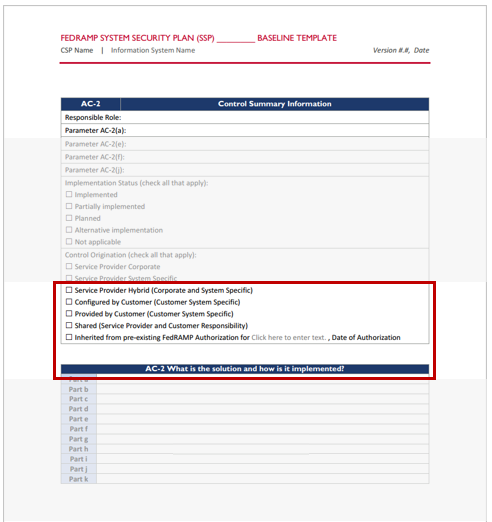
- Control Origination
- Responding By Component
- Control Implementation Statements
- Control Response: Policies, Procedures, Plans, RoB, and Guides
- Inheritence and Customer Responsibilities
- Citing Control Statements
Control Response: Approaches
OSCAL offers a great deal of flexibility for controls responses. To balance consistency, interoperability and ease of adoption, the OSCAL Foundation recommends two approaches:
- Flat Approach: Aligns with FedRAMP's SSP Word template where control responses are at the statement level, and the narriative alone distinguishes between compoents within the response.
- Normalized Approach: Control responses are decomposed to align with relevant components.
With the flat approach, the entire statement-level response from a FedRAMP Word-based SSP is represented "as-is" in a single by-component assembly in OSCAL.
See Control Response: Flat Approach for more information.
Retrofit Adoption Path: MVP
If you have an existing FedRAMP authorization with an existing Word-based FedRAMP SSP, start with the flat approach and migrate over time to the normalized approach.
With the normalized approach, components are associated with control response statements. Responses are possible either for the whole statement or assocaited with a specific component relative to the statement response.
See Control Response: Normalized Approach for more information.
New Adoption Path: Core
If you are adopting OSCAL at the beginning of your FedRAMP journey, respond to control statements at the component level as much as practical. Define OSCAL components ahead of time, and be prepared to add components as needed for control response authoring.
Control Response: Flat Approach
The flat approach to control responses is only intended as a starting point for service providers converting from a legacy FedRAMP SSP Word template.
If you are not converting a legacy SSP, use the Control Response: Normalized Approach.
With the flat approach, the entire statement-level response from a FedRAMP Word-based SSP is represented "as-is" in a single by-component entry in OSCAL.

Retrofit Adoption Path: MVP
With OSCAL SSPs, all control responses must be assocaited with a component. To ensure this is always possible, OSCAL SSPs also require the existence of a this system component, which represents the entire system.
When converting from a legacy Word-based SSP, the simpelest form of OSCAL adoption is to move the text from each control statement response into the "this system" component response.
Transition to Normalized
Over time, components can be added to the components array in system-characteristics. Some components will be added in order to represent SSP tables, such as leveraged authorizations, external services and cryptographic modules. Others may be added to support inventory normalization. Add any additional components you need to support or control responses.
At any time, additional by-components entries can be added to a statements entry, and linked to a component. This may occur one component at a time.
Example Transition
The legacy Word-Based SSP, response to AC-1, Statement a is:
Chapters 1 and 2 define purpose and scope, while chapter 3 defines roles. Chapters 4 - 8 define responsibilities and coordination, and chapter 9 confirms maangement commitment and potential penalties.
The PDQ Information System Security Officer developed, maintains and disseminates the PDQ Access Control Procedure, v 1.1 dated March 1, 2026, which defines access control operations for the system. The ISSO ensures all PDQ Cloud System managers and administrators receive a copy of this docuemnt
MVP OSCAL Representation
The entire statement above is represented as follows:
metadata/rolesentries for the ISSO and Trust and Compliance Team.- a
this-systementry in thecomponentsarray - an
implemented-requirementsentry for AC-1 (ac-1)- a
statementsentry for AC-1, part a (ac-1_smt.a)- a
by-componentsentry with thecomponent-uuidvalue of thethis-systementry in thecomponentsarray- a
descriptionfield with the statement from the Word-based SSP.
- a
- a
- a
system-security-plan:
  metadata:
    roles:
    - role-id: information-system-security-officer
      title: ISSO
    - role-id: trust-and-compliance
      title: Corporate Trust and Compliance Team
  system-implementation:
    components:
    - uuid: 11111111-2222-4000-8000-009000000000
      type: this-system
      title: This System
      description: 'This component represents the entire system or authorization boundary.'

  control-implementation:
    description: 'OSCAL-required field.'
    implemented-requirements:
    - uuid: 11111111-2222-4000-8000-012000010000
      control-id: ac-1

      statements:
      - statement-id: ac-1_smt.a
        uuid: 11111111-2222-4000-8000-012000010100
        by-components:
        - component-uuid: 11111111-2222-4000-8000-009000000000
          uuid: 11111111-2222-4000-8000-012000010101

          description: 'The Trust an Compliance Team developed, maintains and disseminates the XYZ Corp Access Control Policy, v2.3 dated January 5th 2024 to all management, administrators and users of the PDQ Cloud System.

Chapters 1 and 2 define purpose and scope, while chapter 3 defines roles. Chapters 4 - 8 define responsibilities and coordination, and chapter 9 confirms maangement commitment and potential penalties.

The PDQ Information System Security Officer developed, maintains and disseminates the PDQ Access Control Procedure, v 1.1 dated March 1, 2026, which defines access control operations for the system. The ISSO ensures all PDQ Cloud System managers and administrators receive a copy of this docuemnt.'

          implementation-status:
            state: implemented
          responsible-roles:
          - role-id: information-system-security-officer
          - role-id: trust-and-compliance
Transition
In moving to the normalized approach, OSCAL components must eventually be defined for required documents. This will result in additional entries to the components array as follows:
- Additional entries to the
componentsarray- a
typeset topolicyorprocess-procedure - a
titlewith the title of the policy or procedure - a
responsible-rolesarray with the appropraite role-id cited.
- a
system-security-plan:
  system-implementation:
    components:
    - uuid: 11111111-2222-4000-8000-009000000001
      type: policy
      title: XYZ Access Control Policy
      description: 'This is the corporate AC Policy.'
      responsible-roles:
      - role-id: trust-and-compliance

    - uuid: 11111111-2222-4000-8000-009000000003
      type: policy
      title: PDQ Access Control Procedure
      description: 'This is the system-specific AC Procedure.'
      responsible-roles:
      - role-id: information-system-security-officer
Once defined, additional by-component entries may be added to the AC-1, part a atatement; however they do not need to be added all at once. For example, the policy may be addressed in one pass and the procedures deferred.
- add one additional
by-componentsentry for the policy - move only the policy portion of the control response
- drop the
trust-and-compliancerole- It is not necessary to move the
trust-and-compliancerole as it is defined for the component above.
- It is not necessary to move the
system-security-plan:
  control-implementation:
    implemented-requirements:
    - uuid: 11111111-2222-4000-8000-012000010000
      control-id: ac-1
      statements:
      - statement-id: ac-1_smt.a
        uuid: 11111111-2222-4000-8000-012000010100
        by-components:

        - component-uuid: 11111111-2222-4000-8000-009000000000
          uuid: 11111111-2222-4000-8000-012000010101

          description: 'The PDQ Information System Security Officer developed, maintains and disseminates the PDQ Access Control Procedure, v 1.1 dated March 1, 2026, which defines access control operations for the system. The ISSO ensures all PDQ Cloud System managers and administrators receive a copy of this docuemnt.'

          implementation-status:
            state: implemented
          responsible-roles:
          - role-id: information-system-security-officer

        - component-uuid: 11111111-2222-4000-8000-009000000001
          uuid: 11111111-2222-4000-8000-012000010102

          description: 'The Trust an Compliance Team developed, maintans and disseminates the XYZ Corp Access Control Policy, v2.3 dated January 5th 2024 to all management, administrators and users of the PDQ Cloud System.

Chapters 1 and 2 define purpose and scope, while chapter 3 defines roles. Chapters 4 - 8 define responsibilities and coordination, and chapter 9 confirms maangement commitment and potential penalties.'

          implementation-status:
            state: implemented
When all components have been added, the original by-components entry for this-system may still be used for providing information (control responses, status differences or additional roles) that do not fit specific component responses.
Control Response: Normalized Approach
The normalized approach is prefered. Organizations starting new with no legacy SSP content should use this.
For organizations converting from a legacy FedRAMP SSP Word template, consider starting with the Control Response: Flat Approach and migrating to the normalized approach over time.
With the normalized approach, system elements are first defined as OSCAL components. Relvant components are then associated with control statements via statements/by-components entries. Control responses are then provided in the approrpiate by-component entry.
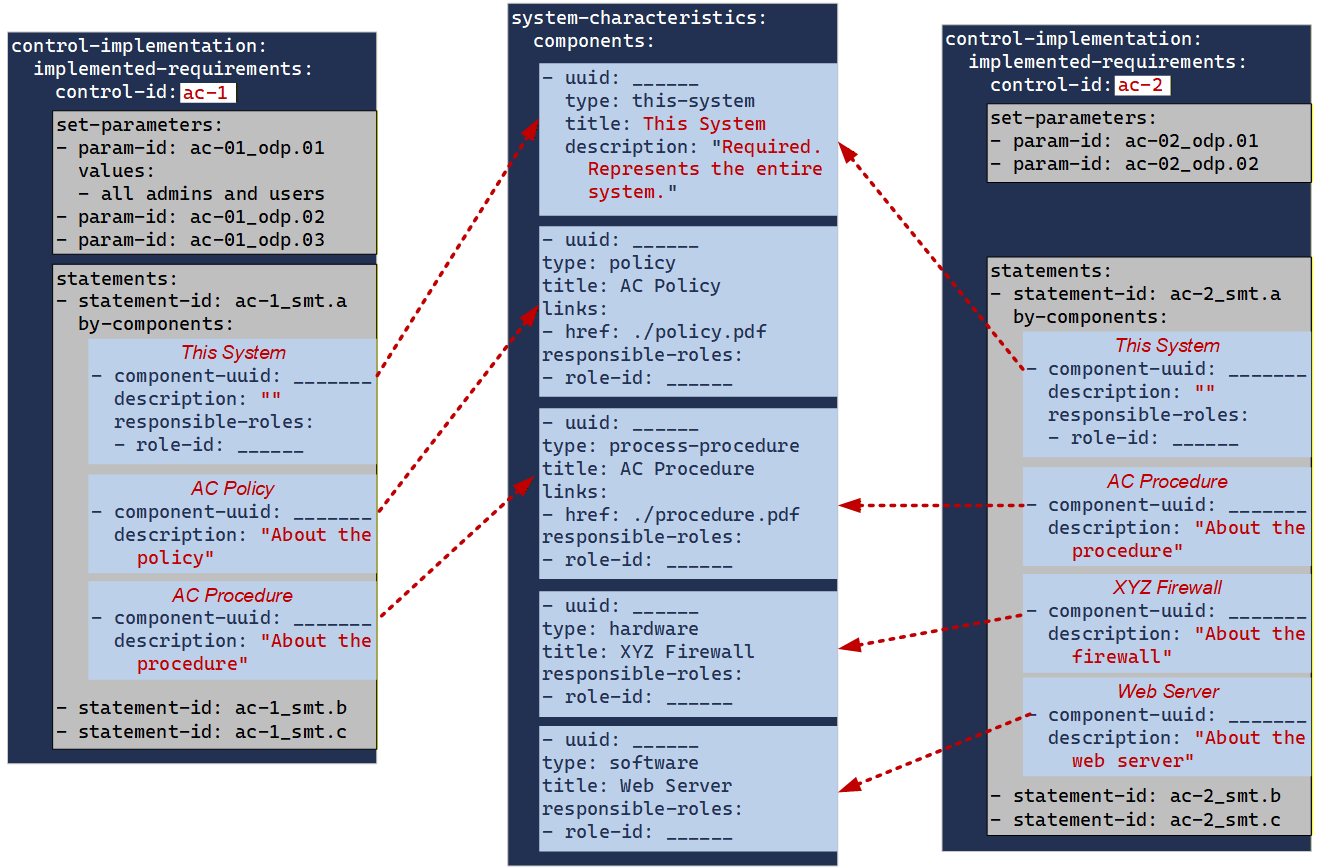
system-security-plan:
Responding to Control Baselines

OSCAL references controls in baselines and catalogs. The statements are not duplicated into an OSCAL SSP the way they are with a Word SSP.
Conrol baseline requirements are imported by an OSCAL SSP and referenced as needed.
Importing a Baseline
Import the appropriate FedRAMP Baseline, either as an OSCAL profile or as an OSCAL reserved profile catalog.
system-security-plan:
  import-profile:
    href: https://raw.githubusercontent.com/OSCAL-Foundation/fedramp-resources/refs/heads/main/baselines/rev5/yaml/FedRAMP_rev5_HIGH-baseline-resolved-profile_catalog.yaml
See Baselines for more information about those files.
Referencing Controls
With the approprate baseline imported above, OSCAL SSP control responses simply cite the control id from the baseline.
For each control in the imported baseline there MUST be exactly one implemented-requirements entry that includes:
- a
uuid - a
control-idwith a value that matches a control in the imported baseline - a
set-parametersarray, only if the control has one or more parameters that don't already have theirvalueestablished in the baseline. See Parameter Assignments for more information. - a
statementsarray contains the control responses. See Control Implementation Statements for more information.
system-security-plan:
  control-implementation:
    description: 'This description field is required by OSCAL, but ignored by FedRAMP.'
    implemented-requirements:

    - uuid: 11111111-2222-4000-8000-012000010000
      control-id: ac-1
      set-parameters:
        [content cut]
      statements:
        [content cut]

    - uuid: 11111111-2222-4000-8000-012000010001
      control-id: ac-2
      [content cut]

    - uuid: 11111111-2222-4000-8000-012000010002
      control-id: ac-2.1
      [content cut]
Responsible Roles
Every control should have one or more responsible roles identified.
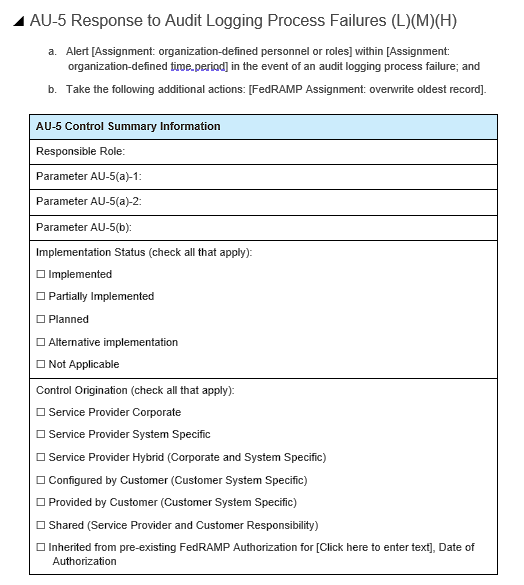
In OSCAL, there are three possible sources for responsible roles:
- By Control: (Retrofit MVP only) assign responsible roles to the
implemented-requirementfor the entire control - By Component (Implied): infer responsible roles from the components cited in the
by-componentarray - By Component (Explicit): assign responsible roles to the
statement/by-componentarray
Retrofit Adoption Path: MVP
When initially converting a Word-based FedRAMP SSP to OSCAL, assign all roles by control to the implemented-requirements/responsible-roles array. This aligns with the FedRAMP Word-based SSP template.
As the SSP is migrated to a normalized approach using components, the assignment of roles is moved from the entire control to statement-level, component responses.
With fully normalized OSCAL content, responsible roles are inferred via the components associated with a control via statements/by-components. Each assocaited component SHOULD have owner and administrator responsible roles and linked to specific parties (teams or individuals).
If additional roles need to be cited, they are explicilty assigned to by-components/responsible-roles. If an explicitly needed role does not associate cleanly to a specific component, it is assigned to the by-components/responsible-roles entry for this system (component type=this-system).
WORKING HERE
Representation
Parameter Assignments
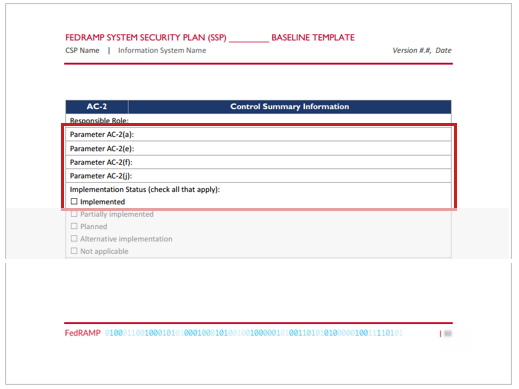
Representation
If a FedRAMP control has one or more parameters, add a set-parameters array Within an implemented-requirements entry. There must be one set-parameters entry for each parameter in the control as follows:
- a
param-idset to the parameter value from the OSCAL-based FedRAMP baselines - a
valuesarray with:- one string entry per response
- If the response is list, such as a list of user types to receive a procedure, add one entry per list item.
system-security-plan:
  control-implementation:
    implemented-requirements:
    - uuid: 11111111-2222-4000-8000-012000010000
      control-id: ac-1
      set-parameters:

      - param-id: ac-01_odp.01
        values:
        - all managers, administrators and users of the system

      - param-id: ac-01_odp.02
        values:
        - all managers and administrators of the system

      - param-id: ac-01_odp.03
        values:
        - System-level

      - param-id: ac-01_odp.04
        values:
        - System Architect

      - param-id: ac-01_odp.05
        values:
        - at least every 3 years

      - param-id: ac-01_odp.06
        values:
        - change in organizational legal status or ownership

      - param-id: ac-01_odp.07
        values:
        - at least annually

      - param-id: ac-01_odp.08
        values:
        - change in policy or a security incident involving a failure of access control
          mechanisms
Selection Parameters and Nested Parameters
Some select parameters contain one or more assignment parameters. In this instance, simply provide the final selection value within the set-parameters entry for the select and omit any set-parameters entries related to the assignment.
Example
AC-7_ part (b) has three assignment parameters nested within a single selection parameter. Line breaks and bullets have been added below to better illustrate the nesting.
Automatically
- [Selection (one or more):
- lock the account or node for an [Assignment: organization-defined time period];
- lock the account or node until released by an administrator;
- delay next logon prompt per [Assignment: organization-defined delay algorithm];
- notify system administrator;
- take other [Assignment: organization-defined action]]
when the maximum number of unsuccessful attempts is exceeded.
Although the OSCAL controls will have four parameters, only the final value for the selection parameter is assigned in the SSP. The other parameters are ignored.
If more than one choice is is applicable, add each as a separate entry in the values array. For example if the final choices are:
- lock the account or node for an [Assignment: 30 minutes];
- lock the account or node until released by an administrator;
The set-parameters array would be:
system-security-plan:
  control-implementation:
    implemented-requirements:
    - uuid: 11111111-2222-4000-8000-012000010000
      control-id: ac-7
      set-parameters:

      - param-id: ac-07_odp.03
        values:
        - lock the account or node for 30 minutes;
        - lock the account or node until released by an administrator;
Parameters ac-07_odp.01 and ac-07_odp.02 belong to part (a). They would normally be included and are only omitted for the example.
Parameters ac-07_odp.04, ac-07_odp.05 and ac-07_odp.06 are part of ac-07_odp.03 and are omitted.
Implementaiton Status
FedRAMP only accepts only one of five values for implementation-status:
implemented, partial, planned, alternative, and not-applicable. A
control may be marked "partial" and "planned" (using two separate
implementation-status fields). All other choices are mutually exclusive.
If the implementation-status is partial, the gap must be explained in the remarks field.
If the implementation-status is planned, a brief description of the
plan to address the gap, including major milestones must be explained in
the remarks field. There must also be a prop
(name="planned-completion-date" ns="http://fedramp.gov/ns/oscal")
field containing the intended completion date. With XML, prop fields
must appear before other sibling fields (such as set-parmeter, responsible-role, etc.), even though that sequence is
counter-intuitive in this situation.
If the implementation-status is alternative, the alternative
implementation must be summarized in the remarks field.
If the implementation-status is not-applicable, the N/A
justification must be provided in the remarks field.
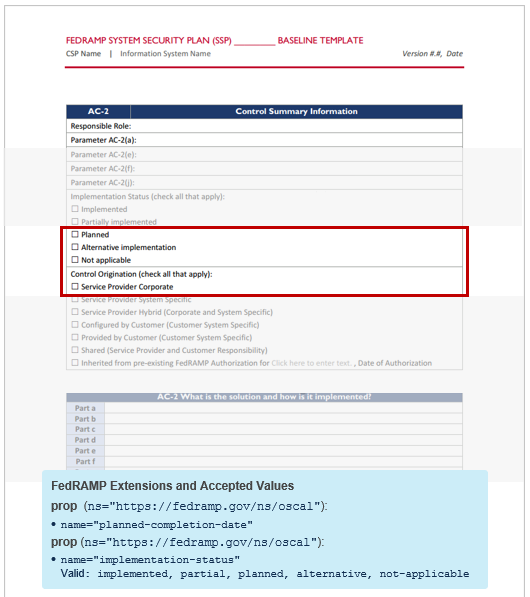
Representation
<!-- system-implementation -->
<control-implementation>
    <implemented-requirement uuid="uuid-value" control-id="ac-1">
        <prop name="planned-completion-date"
            ns="http://fedramp.gov/ns/oscal" value="2021-01-01Z"/>
        <prop name="implementation-status"
            ns="http://fedramp.gov/ns/oscal" value="implemented" />
        <prop name="implementation-status"
            ns="http://fedramp.gov/ns/oscal" value="partial" />
        <prop name="implementation-status"
            ns="http://fedramp.gov/ns/oscal" value="planned" />
        <prop name="implementation-status"
            ns="http://fedramp.gov/ns/oscal" value="not-applicable"/>
        <!-- responsible-role, statement, by-component -->
    </implemented-requirement>
</control-implementation>
<!-- back-matter -->
The FedRAMP implementation-status property at the control's
implemented-requirement level is a summary of all statement and/or
component level core OSCAL implementation-status designations. It must
be set appropriately based on the least value of child statement
or component level implementation-status designations. When a statement
and/or component level implementation-status designation is not
specified, the FedRAMP implementation-status value is assumed.
Individual statements and/or components may override
implementation-status locally.
Control Origination
FedRAMP accepts only one of five values for control-origination:
sp-corporate, sp-system, customer-configured, customer-provided, and
inherited. Hybrid choices are expressed by identifying more than one
control-origination, each in a separate prop field.
For controls with a control-id ending in "-1", FedRAMP only accepts
sp-corporate and sp-system.
If the control origination is inherited, there must also be a FedRAMP extension (prop name="leveraged-authorization-uuid" ns="http://fedramp.gov/ns/oscal") field containing the UUID of the leveraged authorization as it appears in the /*/system-implementation/leveraged-authorization assembly.
Representation
<system-implementation>
    <!-- status -->
    <leveraged-authorization uuid="uuid-of-leveraged-authorization">
        <!-- details cut - see Leveraged Authorizations Section -->
    </leveraged-authorization>
</system-implmentation>

<control-implementation>
    <implemented-requirement uuid="uuid-value" control-id="ac-2">
        <prop name="leveraged-authorization-uuid"
            value="uuid-of-leveraged-authorization"/>
        <prop ns="http://fedramp.gov/ns/oscal" name="control-origination"
            value="sp-corporate" />
        <prop ns="http://fedramp.gov/ns/oscal" name="control-origination"
            value="sp-system" />
        <prop ns="http://fedramp.gov/ns/oscal" name="control-origination"
            value="customer-configured" />
        <prop ns="http://fedramp.gov/ns/oscal" name="control-origination"
            value="inherited" />
        <!-- responsible-role -->
    </implemented-requirement>
</control-implementation>
<!-- back-matter -->
Responding By Component
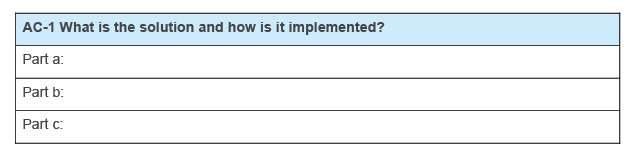
OSCAL SSPs represent control responses in control-implementation / implemented-requirements / statements.
See Control Implementation Statements to understand how to associate control responses with specific baseline controls and control statements.
Within statements, all responses must be assocaited with one or more components via the by-components array.
OSCAL enables you to be as granular as you wish. Individual components may be added for operating systems, container images, firewalls, policies, procedures and plans. There is always a "this-system" component representing the entire system / authorization-boundary.
The "This System" Component
There must always be a "This System" component defined in the SSP. For control responses, this is used in several ways:
-
Holistic Overview: The SSP author may wish to provide a more holistic overview of how several components work together, even if details are provided individually in other
by-componentassemblies. -
Catch-all: Any control response that does not cleanly align with another system component may be described in the "This System" component.
-
Legacy SSP Conversion: When converting a legacy SSP to OSCAL, the legacy control response statements may initially be associated with the "This System" component until the SSP author is able to provide responses for individual components.
responses occur within by-components / description.
In a legacy Word-based SSP, it was often necessary to provide narriative for each relevant component in a control response. The entire narriative for all components was captured in a single table cell as separate paragraphs.
With OSCAL, you have the option of keeping a single narriative block, or breaking out a control response by its discrete components.
Retrofit Adoption Path MVP
When converting a Word-based FedRAMP SSP to OSCAL, move all control responses to the this-system component.
Every OSCAL SSP must have a this-system component defined. It is the only required component.
system-security-plan:
  system-implementation:
    components:
    - uuid: 11111111-2222-4000-8000-009000000000
      type: this-system
      title: This System
      description: 'Represents the entire authorization boundary'
      status:
        state: operational
Every statements / by-components array has exactly one entry that references the this-system component and includes the content from the Word-based SSP.
Each statements array entry includes:
- a required
uuidfield - a required
by-componentsarray. Each array entry includes:- a required
component-uuidfield that cites thethis-sytemcomponent from above. - a required
uuidfield - a required
descriptionfield that contains the content from the Word-based SSP control response. - a required
implementation-statuselement with:- a required
statefield with a value of ofimplemented.
- a required
- a required
system-security-plan:
  control-implementation:
    description: n/a.
    implemented-requirements:
    - uuid: 11111111-2222-4000-8000-012000010000
      control-id: ac-1
      statements:
      - statement-id: ac-1_smt.a
        uuid: 11111111-2222-4000-8000-012000010100
        by-components:
        - component-uuid: 11111111-2222-4000-8000-009000000000
          uuid: 11111111-2222-4000-8000-012000010101
          description: Word-based SSP AC-1, statement a response.
          implementation-status:
            state: implemented
      - statement-id: ac-1_smt.b
        uuid: 11111111-2222-4000-8000-012000010200
        by-components:
        - component-uuid: 11111111-2222-4000-8000-009000000000
          uuid: 11111111-2222-4000-8000-012000010201
          description: Word-based SSP AC-1, statement b response.
      - statement-id: ac-1_smt.c
        uuid: 11111111-2222-4000-8000-012000010300
        by-components:
        - component-uuid: 11111111-2222-4000-8000-009000000000
          uuid: 11111111-2222-4000-8000-012000010301
          description: Word-based SSP AC-1, statement c response.
          implementation-status:
            state: implemented
See the Example below.
Native Adoption Path
When creating an SSP from scratch, ensure appropriate components are defined before authoring a control response. The this-system component must always be present. Other components are present baed on their use within the sytem. See Components for more information.
system-security-plan:
  system-implementation:
    components:
    - uuid: 11111111-2222-4000-8000-009000000000
      type: this-system
      title: This System
      description: 'Represents the entire authorization boundary'
      status:
        state: operational

    - uuid: 11111111-2222-4000-8000-009000600001
      type: policy
      title: Access Control and Identity Management Policy
      description: 'A corporate policy used for the system.'
      status:
        state: operational
Every statements / by-components array has one or more entries that reference components describes how that component is satisfying that control requirement statement.
Each statements array entry includes:
- a required
uuidfield - a required
by-componentsarray. Each array entry includes:- a required
component-uuidfield that cites the appropriate component from above. - a required
uuidfield - a required
descriptionfield that contains the content from the Word-based SSP control response. - a required
implementation-statuselement with:- a required
statefield with a value of ofimplemented.
- a required
- a required
system-security-plan:
  control-implementation:
    description: n/a.
    implemented-requirements:
    - uuid: 11111111-2222-4000-8000-012000010000
      control-id: ac-1
      statements:
      - statement-id: ac-1_smt.a
        uuid: 11111111-2222-4000-8000-012000010100
        by-components:

        - component-uuid: 11111111-2222-4000-8000-009000600001
          uuid: 11111111-2222-4000-8000-012000010102
          description: Describe how this policy satisfies part a.
          implementation-status:
            state: implemented

        - component-uuid: 11111111-2222-4000-8000-009000000000
          uuid: 11111111-2222-4000-8000-012000010101
          description: "Provide general context about satisfying part a that doesn't fit a defined component."
          implementation-status:
            state: implemented
Example
IA-2 Identificaiton and Authentication (Organizational Users) is satisfied by a combination of:
- the IA Policy
- an IA Procedure
- a container running KeyCloak
- an enterprise directory capability
This was originally described in the the IA-2 narriative as:
All components requiring authentication are configured to redirect users to KeyCloak. When a user supplies their ID and KeyCloak recognizes it as belonging to this organization, it redirects the user's authentication attempt to the enterprise directory capability for authentication. The enterprise directory reports the user's authentication success or failure back to KeyCloak. If authentication is successful, KeyCloak generates an access token and passes it back to the compnent requesting authentication.
The IA Policy requires use of the enterprise directory for authentication of organizational users. The system-level IA Procedure provides instructions for admins to configure their compoents to use KeyCloak for authentication.
Within the OSCAL SSP, this entire statement can initially be assocaited with the "this-system" component in the by-component response to AC-2.
by-component(this-system)
All components requiring authentication are configured to redirect users to KeyCloak. When a user supplies their ID and KeyCloak recognizes it as belonging to this organization, it redirects the user's authentication attempt to the enterprise directory capability for authentication. The enterprise directory reports the user's authentication success or failure back to KeyCloak. If authentication is successful, KeyCloak generates an access token and passes it back to the compnent requesting authentication.
The IA Policy requires use of the enterprise directory for authentication of organizational users. The system-level IA Procedure provides instructions for admins to configure their compoents to use KeyCloak for authentication.
Moving Toward Normalization
At a later date, the SSP author can define components for the IA Policy and system-level IA Procedure and associate them with AC-2. The content shifts to be represented like this:
by-component(this-system)
All components requiring authentication are configured to redirect users to KeyCloak. When a user supplies their ID and KeyCloak recognizes it as belonging to this organization, it redirects the user's authentication attempt to the enterprise directory capability for authentication. The enterprise directory reports the user's authentication success or failure back to KeyCloak. If authentication is successful, KeyCloak generates an access token and passes it back to the compnent requesting authentication.
by-component(policy)
The IA Policy requires use of the enterprise directory for authentication of organizational users.
by-component(process-procedure)
The system-level IA Procedure provides instructions for admins to configure their compoents to use KeyCloak for authentication.
Fully Normalized
Eventually, components are added for KeyCloak and the enterprise directory; however, some of this narriative describes how the two work together. The this-system component can still be used for any narriative that doesn't fit cleanly in another component.
by-component(this-system)
All components requiring authentication are configured to redirect users to KeyCloak.
by-component(software/ KeyCloak)
When a user supplies their ID and KeyCloak recognizes it as belonging to this organization, it redirects the user's authentication attempt to the enterprise directory capability for authentication.
If authentication is successful, KeyCloak generates an access token and passes it back to the compnent requesting authentication.
by-component(service/ enterprise directory)
The enterprise directory reports the user's authentication success or failure back to KeyCloak.
by-component(policy)
The IA Policy requires use of the enterprise directory for authentication of organizational users.
by-component(process-procedure)
The system-level IA Procedure provides instructions for admins to configure their compoents to use KeyCloak for authentication.
This is now fully normalized.
Control Implementation Statements
Typically, the controls in the FedRAMP baselines have lettered parts (a., b., etc.). A few only have a top-level statement with no parts. Current FedRAMP templates expect responses at the lettered part level when present and at the top-level otherwise.
OSCAL SSPs cite controls and control requirement statements in responses.
Within the OSCAL FedRAMP baselines, each control statement is assigned an identifier. Any lettered parts are also assigned identifiers.
Citing statement identifiers correctly is critical to automated processing.
See Citing Control Statements for important information.
Typical

Most FedRAMP controls have two or more lettered parts. FedRAMP expects control responses at this level.
Within the control-implementation / implemented-requirements array, each entry includes:
- a required
uuidfield - a required
control-idfield that cites the control using its id from the baseline. - a required
statementsarray. Each array entry includes:- a
statement-idfield that cites the control statement using its id from the baseline. - a
by-componentsarray- See Responding By Component for more information.
- a
Multi-Part Statement Representation
system-security-plan:
  control-implementation:
    implemented-requirements:
    - uuid: 11111111-2222-4000-8000-012000010000
      control-id: ac-1
      statements:
      - statement-id: ac-1_smt.a
        uuid: 11111111-2222-4000-8000-012000010100
        by-components:
          [content cut]
Non-Typical
If there are no lettered parts in the control definition, such as with AC-2 (1), there must be exactly one statement assembly.
Single-Statement Representation

A single-statement representation is identical to a typical multi-part statement representation, except for the following:
- there is only one entry in the
statementsarray - the
statement-idvalue cites the baseline ID for thestatementpart itself instead of one of its child parts.
system-security-plan:
  control-implementation:
    implemented-requirements:
    - uuid: 11111111-2222-4000-8000-012000010000
      control-id: ac-2.1
      statements:
      - statement-id: ac-2.1_smt
        uuid: 11111111-2222-4000-8000-012000010100
        by-components:
          [content cut]
Control Response: Policies, Procedures, Plans, RoB, and Guides
Most FedRAMP-required attachments derive their requirement from one or more NIST SP 800-53 controls. With an OSCAL SSP, the attachment is linked directly from the control. This is how tools know which attachment satisfies each requirement.
| Control ID | Artifact to Link | Expected |
|---|---|---|
Each -1 |
Policy | 1 |
Each -1 |
Procedure(s) | 1+ |
SA-5 (id=sa-5) |
Appendix D: User Guide | 1 |
PL-4 (id=pl-4) |
Rules of Behavior | 1 |
CP-2 (id=cp-2) |
Information System Contingency Plan (ISCP) | 1 |
CM-9 (id=cm-9) |
Configuration Management Plan (CMP) | 1 |
IR-8 (id=ir-8) |
Incident Response Plan (IRP) | 1 |
CA-7 (id=ca-7) |
Continuous Monitoring Plan | 1 |
SR-2 (id=sr-2) |
Supply Chain Risk Management Plan (SCRMP) | 1 |
Retrofit MVP
For Retrofit MVP, simply use a links array in the implemented-requirements entry for each "-1" control.
system-security-plan:
  control-implementation:
    description: There is one control in this example. Follow this pattern for each
      additional control.
    implemented-requirements:
    - uuid: 11111111-2222-4000-8000-012000010000
      control-id: ac-1
      links:
      - href: ./AC_Policy.docx
        rel: policy
        media-type: application/docx
      - href: ./AC_Procedure.docx
        rel: procedure
        media-type: application/docx
Normalized
For Retrofit Advanced, and all New adoption:
- Attach the document as a back-matter resource.
- Create a component that represents the document
- Specify the component in the control response
Attach Document
Attach each document as back-matter / resources entries and include a props array with:
nameset totypevalueset topolicy,procedure,plan,users-guideorrules-of-behavior
system-security-plan:

  back-matter:
    resources:
    - uuid: 11111111-2222-4000-8000-001000000005
      title: Access Control and Identity Management Policy
      description: A single policy that addresses both the AC and IA families.
      props:
      - name: type
        value: policy
      - name: published
        value: '2023-01-01T00:00:00Z'
      - name: version
        value: '1.2'
      rlinks:
      - href: ./attachments/policies/sample_AC_and_IA_policy.pdf
        media-type: application/pdf
Create Component
Create a component for each document in system-implementation / components and include:
- a
propsarray with one entry:nameset toimplementation-pointvalueset tointernalif the document is system-specific; orvalueset toexternalandclassset tocorporateif the document is Corporate
- a
linksarray with one entry:hrefcontains a URI fragment that cites the back-matter resource- a hashtag (
#) followed by the UUID of the back-matter resource.
- a hashtag (
relcontainsattachment
All other fields depicted in the example are required by OSCAL to be present.
system-security-plan:

  system-implementation:
    components:
    - uuid: 11111111-2222-4000-8000-009000600001
      type: policy
      title: Access Control and Identity Management Policy
      description: 'This is a corporate AC policy used for the system.'
      props:
      - name: implementation-point
        value: external
        class: corporate
      links:
      - href: '#11111111-2222-4000-8000-001000000005'
        rel: attachment
      status:
        state: operational
Control Response
Use implemented-requirements / statements / by-components entries in every control response that cites the document.
system-security-plan:

  control-implementation:

    implemented-requirements:
    - uuid: 11111111-2222-4000-8000-012000010000
      control-id: ac-1

      statements:
      - statement-id: ac-1_smt.a
        uuid: 11111111-2222-4000-8000-012000010100

        by-components:
        - component-uuid: 11111111-2222-4000-8000-009000600001
          uuid: 11111111-2222-4000-8000-012000010102
          description: Describe how this policy satisfies part a.
          implementation-status:
            state: implemented
Inheritence and Customer Responsibilities
For systems that may be leveraged, OSCAL enables a robust mechanism for providing both inheritance details as well as customer responsibilities (referred to as consumer responsibilities by NIST). OSCAL is designed to enable leveraged and leveraging system SSP details to be linked by tools for validation.
Within the appropriate by-component assembly, include an export assembly. Use provided to identify a capability that may be inherited by a leveraging system. Use responsibility to identify a customer responsibility. If a responsibility must be satisfied to achieve inheritance, add the provided-uuid flag to the responsibility field.
Representation
system-security-plan:
  control-implementation:
    implemented-requirements:
    - uuid: 11111111-2222-4000-8000-012000020000
      control-id: ac-2

      statements:
      - statement-id: ac-2_smt.a
        uuid: 11111111-2222-4000-8000-012000020100
        by-components:
        - component-uuid: 11111111-2222-4000-8000-009000000000
          uuid: 11111111-2222-4000-8000-012000020102
          description: 'Confidential control response.'
          implementation-status:
            state: implemented

          export:
            provided:
            - uuid: 11111111-2222-4000-8000-015000000001
              description: This system's statement of capabilities which may be inherited
                by a customer's leveraging systems toward satisfaction of AC-2, part a.

            responsibilities:
            - uuid: 11111111-2222-4000-8000-016000000001
              provided-uuid: 11111111-2222-4000-8000-015000000001
              description: 'Leveraged system''s statement of a leveraging system''s
                responsibilities in satisfaction of AC-2, part a.'
              responsible-roles:
              - role-id: cloud-service-provider
                party-uuids:
                - 11111111-2222-4000-8000-004000000001
See the NIST OSCAL Leveraged Authorization Presentation for more information.
Leveraged Authorization Response: Inheriting Controls, Satisfying Responsibilities
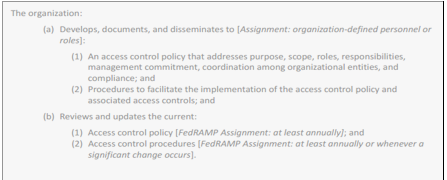
When the current system is inheriting a control from or meeting customer responsibilities defined by an underlying authorization, the leveraged system must first be defined as described in the Response: Identifying Inheritable Controls and Customer Responsibilities section, and documented a component int the leveraging system SSP before it may be referenced in a control response. The by-component assembly references these components.
IMPORTANT: The leveraged system may provide a single component representing the entire leveraged system or may provide individual system components as well. In either case, the inherited-uuid property in the component must have the value flag set to the UUID of the leveraged system or component.
Representation
system-security-plan:
  system-implementation:
    components:
    - uuid: 11111111-2222-4000-8000-009000100004
      type: system
      title: Leveraged Authorized System
      description: Briefly describe the leveraged system.
      status:
        state: operational


  control-implementation:
    implemented-requirements:
      statements:
        by-components:
        - component-uuid: 11111111-2222-4000-8000-009000000004
          uuid: 11111111-2222-4000-8000-012000020104
          description: For the portion inherited from an underlying FedRAMP-authorized
            provider, describe **what** is inherited.
          implementation-status:
            state: implemented
          inherited:
          - uuid: 11111111-2222-4000-8000-017000000001
            provided-uuid: 11111111-0000-4000-9009-002001002001
            description: 'Optional description.'
          satisfied:
          - uuid: 11111111-2222-4000-8000-018000000001
            responsibility-uuid: 11111111-0000-4000-9009-002001002002
            description: 'Description of how the responsibility was satisfied.'
See the NIST OSCAL Leveraged Authorization Presentation for more information.
Citing Control Statements
OSCAL SSPs cite OSCAL baseline statement identifiers when representing control implementation responses. Citing the identifiers correctly is critical to machine processing.
Within OSCAL baselines, identifiers are assigned to statement parts and item parts for reference by SSPs.
The statement Part
All OSCal parts entries have:
- a required
idfield; and - a required
namefield.
For every control in the FedRAMP baselines there is exactly one parts entry where name = statement. This is the statement part.
      - id: ac-2.1
        title: Automated System Account Management
        parts:
        - id: ac-2.1_smt
          name: statement
Simple Controls
For simple controls, the statement part has a prose field that includes the control requirement statement.
      - id: ac-2.1
        title: Automated System Account Management
        parts:
        - id: ac-2.1_smt
          name: statement
          prose: 'Support the management of system accounts using {{ insert: param, ac-02.01_odp }}.'
The id value for the statement part (i.e. ac-2.1_smt) is cited by the SSP's statements array when responding to this control.
Controls with Child Statements
For a control with child statements (a., b., etc.), the statement part includes a nested parts array. Every element in the nested parts array has:
- a required
idfield; and - a required
namefield. Always with a value ofitem. - a
prosefield that includes this part of the control requirement statement. - an additional nested
partsarray IF this part has child parts.
Each control in the FedRAMP OSCAL baselines has a parts array at the root of the control. Each parts entry includes:
- a required
id - a required
name.
catalog:
  groups:
    controls:
    - id: ac-1
      title: Policy and Procedures
      parts:
      - id: ac-1_smt
        name: statement
        parts:
        - id: ac-1_smt.a
          name: item
          props:
          - name: label
            value: 'a.'
          prose: 'Develop, document, and disseminate to {{ insert: param, ac-1_prm_1 }}:'
For SSP authoring, ignore any parts entry in the baseline outside of the statement part and its child parts. Other part types are for control assessments.
Response Point Properties
A response-point property appears in the props array and includes:
- a
nameset toresponse-point - a
nsset tohttp://fedramp.gov/ns/oscal - a
valuewith a value that is any string and can be ignored.
      - id: ac-2.1
        title: Automated System Account Management
        parts:
        - id: ac-2.1_smt
          name: statement
          props:
          - name: response-point
            ns: http://fedramp.gov/ns/oscal
            value: You must fill in this response point.
          prose: 'Support the management of system accounts using {{ insert: param, ac-02.01_odp }}.'
When an SSP tool encounters a parts entry that contains this property, it should be presented to users of SSP authoring tools as the expected level of response for that control.