# Sections 1 - 11
# 1. Introduction
This entire chapter is FedRAMP PMO boilerplate and does not need to be represented in OSCAL content.
# 2. Purpose
This entire chapter is FedRAMP PMO boilerplate and does not need to be represented in OSCAL content.
# 3. System Information
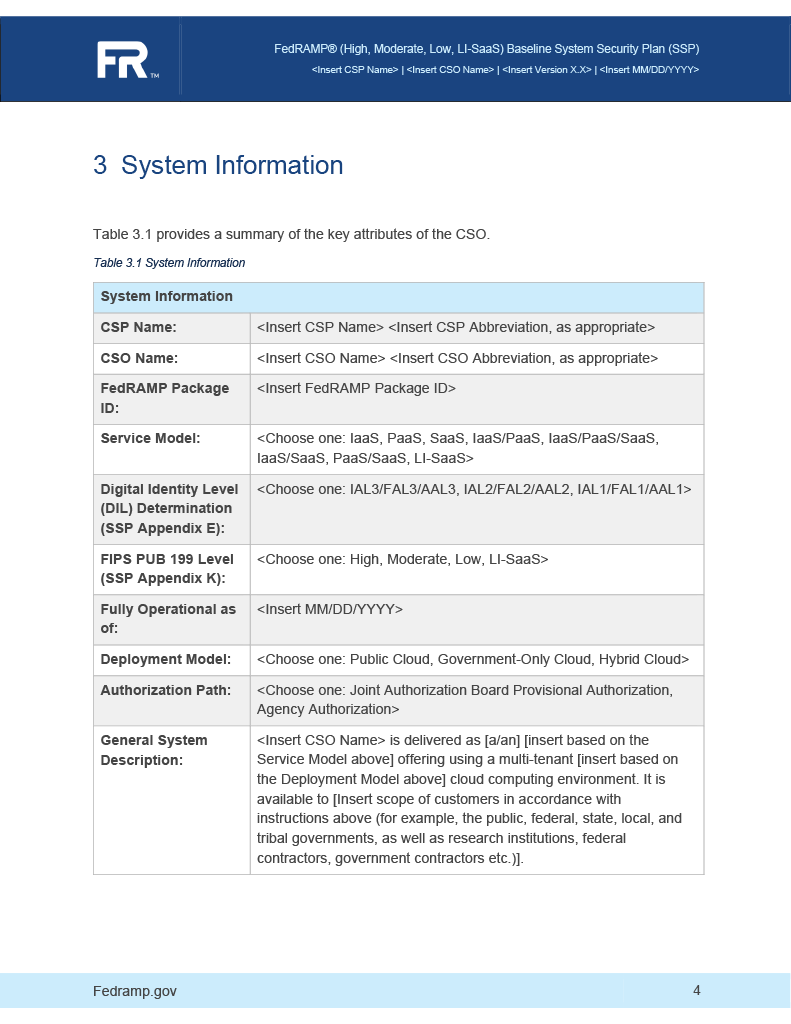 ## System Information
### CSP Name
The cloud service provider (CSP) name and abbreviation are represented in the SSP `metadata`.
- A `roles` extry must exist with `id` = `cloud-service-provider`
- A `parties` entry must exist with the CSP's `name` and `short-name`.
- A `responsible-parties` entry must exist to link the `parties` UUID value to the `cloud-service-provider` role.
#### OSCAL Representation
```yaml
system-security-plan:
uuid: 11111111-2222-4000-8000-000000000000
metadata:
roles:
- id: cloud-service-provider
title: Cloud Service Provider
short-name: CSP
parties:
- uuid: 11111111-2222-4000-8000-004000000001
type: organization
name: Cloud Service Provider (CSP) Name
short-name: CSP Acronym/Short Name
responsible-parties:
- role-id: cloud-service-provider
party-uuids:
- 11111111-2222-4000-8000-004000000001
```
---
### CSO Name
The CSO name and abbreviation are represented in `system-characteristics`.
- The `system-name` field contains the CSO Name
- The `system-name-short` field contains the CSO abbreviation.
#### OSCAL Representation
```yaml
system-security-plan:
system-characteristics:
system-name: System's Full Name
system-name-short: System's Short Name or Acronym
system-ids:
- identifier-type: http://fedramp.gov/ns/oscal
id: F00000000
```
---
### FedRAMP Package ID
The FedRAMP Package ID is represented in `system-characteristics`.
- A `system-ids` entry must exist that includes:
- `identifier-type` set to `http://fedramp.gov/ns/oscal`
- `id` set to the FedRAMP Package ID
#### OSCAL Representation
```yaml
system-security-plan:
system-characteristics:
system-ids:
- identifier-type: http://fedramp.gov/ns/oscal
id: F00000000
```
## System Information
### CSP Name
The cloud service provider (CSP) name and abbreviation are represented in the SSP `metadata`.
- A `roles` extry must exist with `id` = `cloud-service-provider`
- A `parties` entry must exist with the CSP's `name` and `short-name`.
- A `responsible-parties` entry must exist to link the `parties` UUID value to the `cloud-service-provider` role.
#### OSCAL Representation
```yaml
system-security-plan:
uuid: 11111111-2222-4000-8000-000000000000
metadata:
roles:
- id: cloud-service-provider
title: Cloud Service Provider
short-name: CSP
parties:
- uuid: 11111111-2222-4000-8000-004000000001
type: organization
name: Cloud Service Provider (CSP) Name
short-name: CSP Acronym/Short Name
responsible-parties:
- role-id: cloud-service-provider
party-uuids:
- 11111111-2222-4000-8000-004000000001
```
---
### CSO Name
The CSO name and abbreviation are represented in `system-characteristics`.
- The `system-name` field contains the CSO Name
- The `system-name-short` field contains the CSO abbreviation.
#### OSCAL Representation
```yaml
system-security-plan:
system-characteristics:
system-name: System's Full Name
system-name-short: System's Short Name or Acronym
system-ids:
- identifier-type: http://fedramp.gov/ns/oscal
id: F00000000
```
---
### FedRAMP Package ID
The FedRAMP Package ID is represented in `system-characteristics`.
- A `system-ids` entry must exist that includes:
- `identifier-type` set to `http://fedramp.gov/ns/oscal`
- `id` set to the FedRAMP Package ID
#### OSCAL Representation
```yaml
system-security-plan:
system-characteristics:
system-ids:
- identifier-type: http://fedramp.gov/ns/oscal
id: F00000000
```
**FedRAMP Allowed Value**
Required Identifier Type:
- identifier-type="https://fedramp.gov"
---
### Service Model
The Service Model is represented in `system-characteristics`.
- A `system-characteristics` property (`prop`) entry must exist that includes:
- A `name` set to `cloud-service-model`
- A `value` set to one of the allowed service model values below.
- If the `value` is set to `other`, `remarks` is used to explain.
If more than one service model type is applicable (IaaS and PaaS; IaaS and PaaS and SaaS; PaaS and SaaS), use one "cloud-service-model" prop for _each_ applicable cloud service model.
#### OSCAL Representation
```yaml
system-security-plan:
system-characteristics:
props:
- name: cloud-service-model
value: iaas
- name: cloud-service-model
value: paas
- name: cloud-service-model
value: other
remarks: Remarks are required if service model is "other". Optional otherwise.
```
**OSCAL Allowed Values**
Valid `cloud-service-model` property values:
- `saas`
- `paas`
- `iaas`
- `other`
---
### Digital Identity Level (DIL) Determination
See [Appendix E](https://patterns.rufrisk.com/books/fedramp-system-security-plan-ssp/page/appendix-e-digital-identity-level-dil-determination) for appropriate OSCAL representation.
---
### FIPS PUB 199 Level
See [Appendix K](https://patterns.rufrisk.com/books/fedramp-system-security-plan-ssp/page/appendix-k-fips-199-worksheet) for appropriate OSCAL representation.
---
### Fully Operational as of
The fully operational date is represented in `system-characteristics`.
- A `system-characteristics` property (`prop`) entry must exist that includes:
- A `name` set to `fully-operational-date`
- A `ns` set to `http://fedramp.gov/ns/oscal`
- A `value` set to the operational date.
Although the `value` field is a string, the date should be treated as an OSCAL [date-time-with-timezone](https://pages.nist.gov/metaschema/specification/datatypes/#date-time-with-timezone) data type.
#### OSCAL Representation
```yaml
system-security-plan:
system-characteristics:
props:
- name: fully-operational-date
ns: http://fedramp.gov/ns/oscal
value: '2023-12-31T00:00:00Z'
```
---
### Deployment Model
The Deployment Model is represented in `system-characteristics`.
- A `system-characteristics` property (`prop`) entry must exist that includes:
- A `name` set to `deployment-model`
- A `value` set to one of the allowed deployment model values below.
- If the `value` is set to `other`, `remarks` is used to explain.
- Only one `cloud-deployment-model` property is permitted.
If the deployment model is `hybrid` or `other`, the remarks field is required. Otherwise, it is optional.
#### OSCAL Representation
```yaml
system-security-plan:
system-characteristics:
props:
- name: cloud-deployment-model
value: hybrid-cloud
remarks: Remarks are required if deployment model is "hybrid-cloud" or "other". Optional otherwise.
```
**FedRAMP Accepted Values**
Valid `cloud-deployment-model` property values:
- `public-cloud`
- `private-cloud`
- `government-only-cloud`
- `hybrid-cloud`
- `other`
Although core OSCAL also allows `community-cloud`, FedRAMP authorizations do not include community clouds.
---
### Authorization Path
This is an obsolete concept and does not need to be represented in OSCAL.
---
### General System Description
The General System Description is represented in `system-characteristics`.
- The `description` field contains the general system description.
- This is a [markup-multiline](https://pages.nist.gov/metaschema/specification/datatypes/#markup-multiline) field.
#### OSCAL Representation
```yaml
system-security-plan:
system-characteristics:
description: '\[Insert CSO Name\] is delivered as \[a/an\] \[insert based on the Service Model above\] offering using a multi-tenant \[insert based on the Deployment Model above\] cloud computing environment. It is available to \[Insert scope of customers in accordance with instructions above (for example, the public, federal, state, local, and tribal governments, as well as research institutions, federal contractors, government contractors etc.)\].'
```
# 4. System Owner
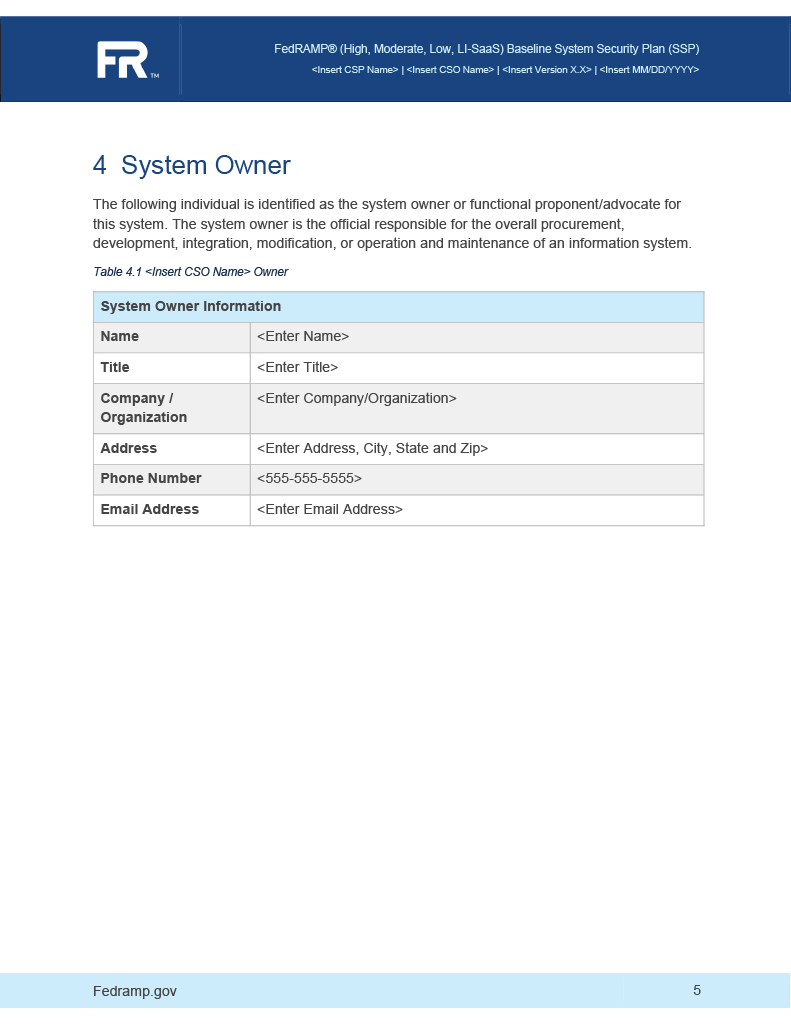 _System Owner_ follows the [Roles](https://patterns.rufrisk.com/books/fedramp-common/page/roles) pattern, using the `system-owner` role.
**Defined Identifiers**
Required Role ID:
- `system-owner`
---
# 5. Assignment of Security Responsibility
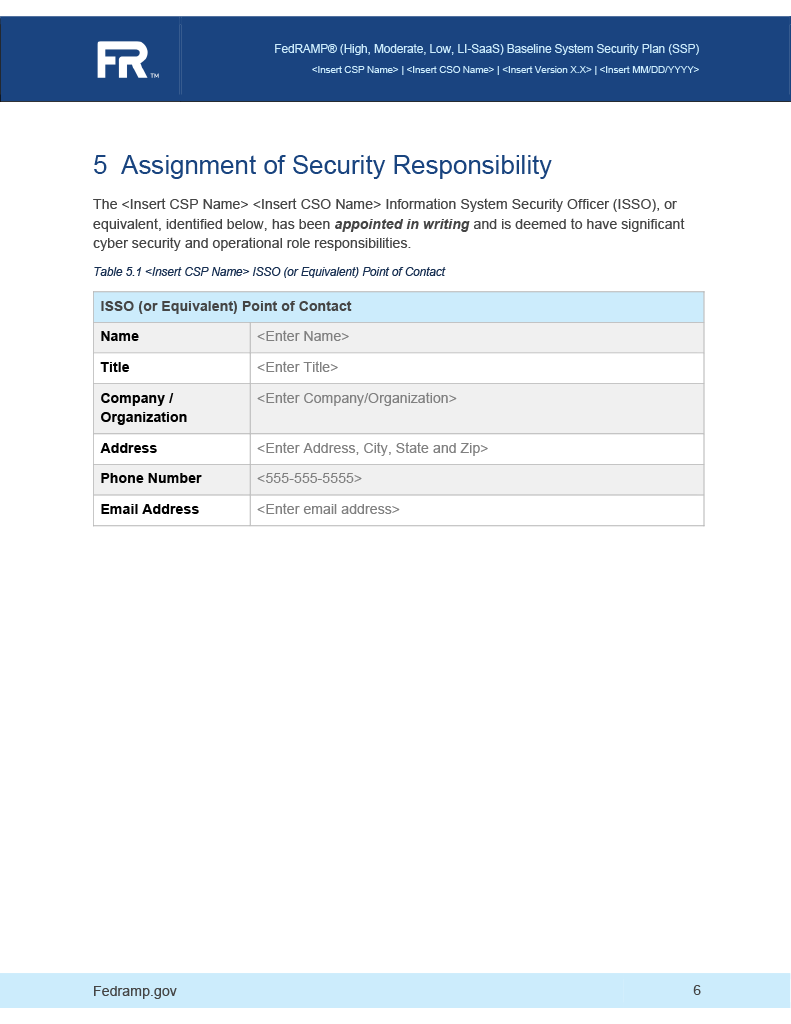 _Information System Security Officer (ISSO)_ follows the [Roles](https://patterns.rufrisk.com/books/fedramp-common/page/roles) pattern, using the `information-system-security-officer` role.
**Defined Identifiers**
Required Role ID:
- `information-system-security-officer`
---
# 6. Leveraged FedRAMP-Authorized Services
The leveraged FedRAMP-Authorized services table is used to list both underlying leveraged authorizations, such as a SaaS running on an IaaS, and use of external cloud services with FedRAMP authorizations, such as a FedRAMP-authorized third party identity management service.
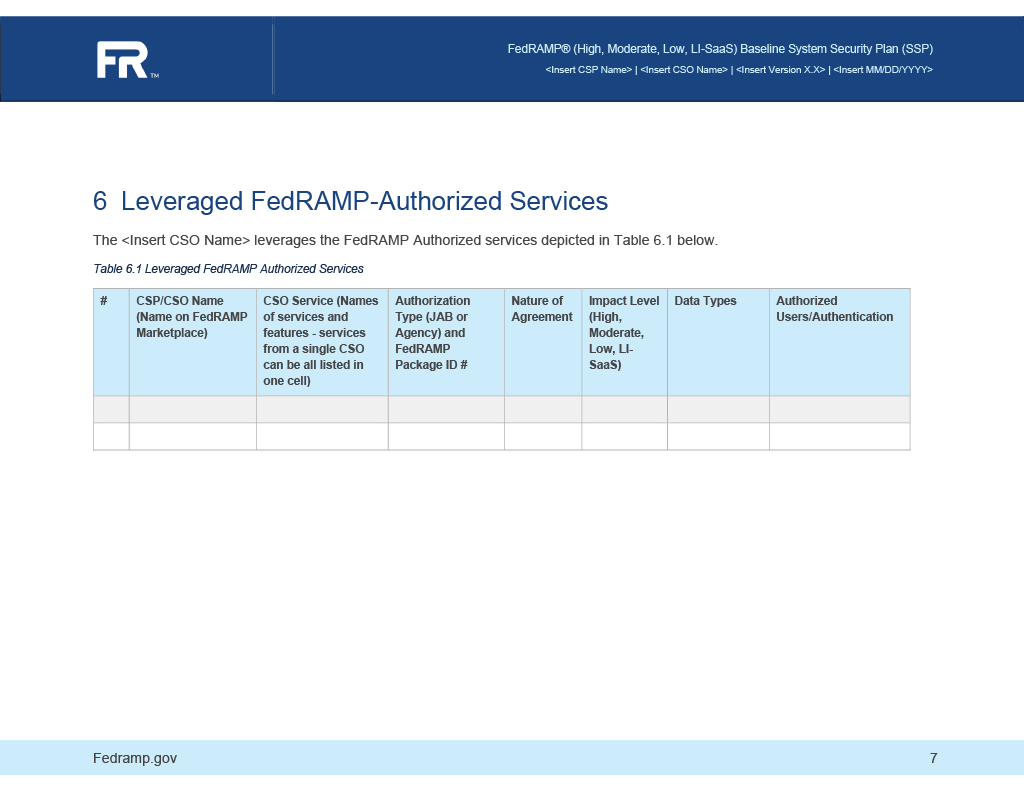 For each row in Table 6.1 there must be:
- a `parties` entry
- a `leveraged-authorizations` entry
- a `components` entry
### `parties` Entry
A `parties` entry to indicate the organizaiton that owns the leveraged system or external service
```yaml
system-security-plan:
metadata:
parties:
- uuid: 22222222-2222-4000-8000-004000000001
type: organization
name: Leveraged System Provider's Name
short-name: LSPN
```
### `leveraged-authorizations` Entry
The `leveraged-authorizations` entry must include:
- a `uuid`
- a `title` with the name of the system or service exactly as it appears in the FedRAMP Marketplace
- a `props` entry with:
- `name` set to `package-id`
- `ns` set to `http://fedramp.gov/ns/oscal`
- `value` set to the package ID exactly as it appears in the FedRAMP Marketplace
- a `props` entry with:
- `name` set to `security-sensitivity-level`
- `ns` set to `http://fedramp.gov/ns/oscal`
- `value` set to `fips-199-low`, `fips-199-modarete` or `fips-199-high` consistent with the FedRAMP Marketplace Information
- a `party-uuid` with the UUID of the `parties` entry above
- a `date-authorized` with the date listed in the FedRAMP Marketplace, expressed in [OSCAL `date` format](https://pages.nist.gov/metaschema/specification/datatypes/#date).
For each row in Table 6.1 there must be:
- a `parties` entry
- a `leveraged-authorizations` entry
- a `components` entry
### `parties` Entry
A `parties` entry to indicate the organizaiton that owns the leveraged system or external service
```yaml
system-security-plan:
metadata:
parties:
- uuid: 22222222-2222-4000-8000-004000000001
type: organization
name: Leveraged System Provider's Name
short-name: LSPN
```
### `leveraged-authorizations` Entry
The `leveraged-authorizations` entry must include:
- a `uuid`
- a `title` with the name of the system or service exactly as it appears in the FedRAMP Marketplace
- a `props` entry with:
- `name` set to `package-id`
- `ns` set to `http://fedramp.gov/ns/oscal`
- `value` set to the package ID exactly as it appears in the FedRAMP Marketplace
- a `props` entry with:
- `name` set to `security-sensitivity-level`
- `ns` set to `http://fedramp.gov/ns/oscal`
- `value` set to `fips-199-low`, `fips-199-modarete` or `fips-199-high` consistent with the FedRAMP Marketplace Information
- a `party-uuid` with the UUID of the `parties` entry above
- a `date-authorized` with the date listed in the FedRAMP Marketplace, expressed in [OSCAL `date` format](https://pages.nist.gov/metaschema/specification/datatypes/#date).
**FedRAMP Extensions**
FedRAMP Extensions are defined when there is no way to represent required information using core OSCAL. They are depicted as propterties (`props` entries) with a namespace (`ns`) value set to `http://fedramp.gov/ns/oscal`. Without the namespace, these properties may be ignored or flagged as invalid.
```yaml
system-security-plan:
system-implementation:
leveraged-authorization:
- uuid: 11111111-2222-4000-8000-019000000001
title: CSO Name
props:
- name: package-id
ns: http://fedramp.gov/ns/oscal
value: F9999999999
- name: security-sensitivity-level
ns: http://fedramp.gov/ns/oscal
value: fips-199-high
party-uuid: 22222222-2222-4000-8000-004000000001
date-authorized: '2015-01-01'
```
**Allowed Values**
The FedRAMP extension `security-sensitivity-level`:
- `fips-199-high`
- `fips-199-moderate`
- `fips-199-low`
### `components` Entry
The `components` entry must include:
- a `uuid `
- a `type` set to `system`
- a `title` set to the name of the leveraged system
- a `description` of the system. This is a core OSCAL requirement. FedRAMP has no specific requirement for the content of this field.
- a `props` entry with:
- `name` set to `leveraged-authorization-uuid`
- `value` set to the UUID of the `leveraged-authorization` entry above
- a `props` entry with:
- `name` set to `nature-of-agreement`
- `ns` set to `http://fedramp.gov/ns/oscal`
- `value` set to `sla`, `contract` [needs more definition]
- a `props` entry with:
- `name` set to `authentication-method`
- `ns` set to `http://fedramp.gov/ns/oscal`
- `value` set to the package ID exactly as it appears in the FedRAMP Marketplace
- One `props` entry for each "Data Type":
- `name` set to `information-type`
- `ns` set to `http://fedramp.gov/ns/oscal`
- `value` set to the NIST SP 800-60 Volume 2 information ID
- `class` set to `incoming` or `outgoing`
- If the same information type is exchanged in both directions, there must be one `props` entry for incoming and a separate props entry for outgoing.
- The `status` assembly with the `state` field set to `operational`
- For FedRAMP the value must always be operational; however, this is a required OSCAL field and cannot be omitted.
- One or more `responsible-roles` entries:
- Identify the Provider (Required):
- `role-id` set to `provider` (ensure `metadata` has a `roles` entry with `id` set to `provider`)
- a `party-uuids` entry with the UUID of the `parties` entry defined above.
- _Authorized Users_: One entry per authorized user type:
- `role-id`
- Use OSCAL-defined canonical values where appropriate.
- If no canonoical value exists, create an appropriate value that conforms with the [OSCAL `token` data type](https://pages.nist.gov/metaschema/specification/datatypes/#token).
- The value must also exist in the `metadata`/`roles` entries.
#### OSCAL Representation
```yaml
system-security-plan:
system-implementation:
component:
- uuid: 11111111-2222-4000-8000-009000100001
type: system
title: Leveraged Authorized System
description: Briefly describe the leveraged system.
props:
- name: leveraged-authorization-uuid
value: 11111111-2222-4000-8000-019000000001
- name: nature-of-agreement
ns: http://fedramp.gov/ns/oscal
value: sla
- name: authentication-method
ns: http://fedramp.gov/ns/oscal
value: 'yes'
- name: information-type
ns: http://fedramp.gov/ns/oscal
value: C.3.5.1
class: incoming
- name: information-type
ns: http://fedramp.gov/ns/oscal
value: C.3.5.8
class: outgoing
status:
state: operational
responsible-roles:
- role-id: provider
party-uuids:
- 11111111-2222-4000-8000-c0040000000a
- role-id: asset-administrator
party-uuids:
- 11111111-2222-4000-8000-c0040000000a
```
### FedRAMP Marketplace Information Matching
Information about _Leveraged FedRAMP Authorized Services_ must match the content in the FedRAMP Marketplace. GSA updates a [JSON file](https://raw.githubusercontent.com/18F/fedramp-data/master/data/data.json) nightly that is used to render the FedRAMP Marketplace data.
| OSCAL Field | GSA Field |
|-------------|-------------------|
| CSP Name | `/data/Providers/[#]/Cloud_Service_Provider_Name` |
| CSO Name | `/data/Providers/[#]/Cloud_Service_Provider_Package` |
| Package ID | `/data/Providers/[#]/Package_ID` |
| Authorization Date | `/data/Providers/[#]/Original_Authorization_Date` |
| Impact Level | `/data/Providers/[#]/Impact_Level` |
**IMPORTANT FOR LEVERAGED SYSTEMS:**
While a leveraged system has no need to represent content here, its SSP SHOULD include special inheritance and responsibility information in the individual controls. See the [*Response: Identifying Inheritable Controls and Customer Responsibilities*](/documentation/ssp/6-security-controls/#response-identifying-inheritable-controls-and-customer-responsibilities) section for more information.
---
# 7. External Systems and Services Not Having FedRAMP Authorization
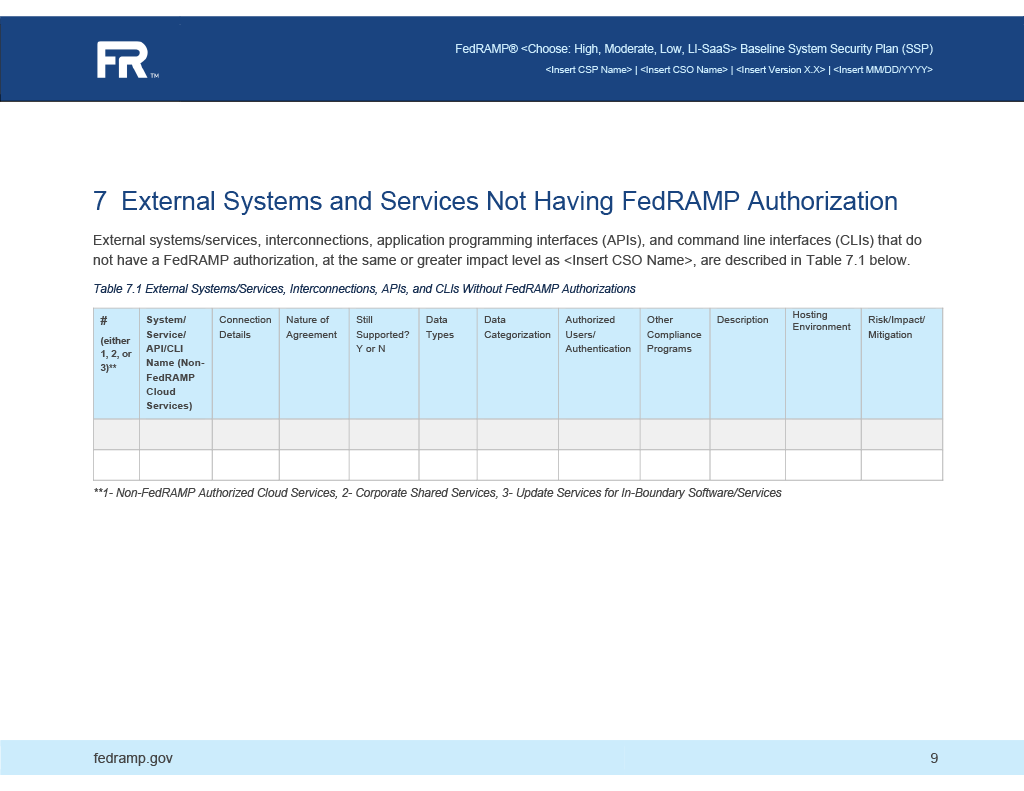
FedRAMP authorized services should be used, whenever possible, since their risk is defined. However, there are instances where CSOs have external systems or services that are not FedRAMP authorized. In OSCAL, these external systems and services must be identified using `component` assemblies with additional FedRAMP namespace and class properties as shown in the OSCAL representation below.
 #### OSCAL Representation
```yaml
system-security-plan:
system-implementation:
component:
uuid: 11111111-2222-4000-8000-009000200001
type: interconnection
title: "[EXAMPLE]External System / Service Name"
description: "Briefly describe the interconnection details."
prop:
- ns: "https://fedramp.gov/ns/oscal"
name: service-processor
value: "[SAMPLE] Telco Name"
- ns: "https://fedramp.gov/ns/oscal"
name: interconnection-type
value: "1"
- name: direction
value: incoming
- name: direction
value: outgoing
- ns: "https://fedramp.gov/ns/oscal"
name: nature-of-agreement
value: contract
- ns: "https://fedramp.gov/ns/oscal"
name: still-supported
value: yes
- ns: "https://fedramp.gov/ns/oscal"
class: fedramp
name: interconnection-data-type
value: "C.3.5.1"
- ns: "https://fedramp.gov/ns/oscal"
class: fedramp
name: interconnection-data-type
value: "C.3.5.8"
- ns: "https://fedramp.gov/ns/oscal"
class: "C.3.5.1"
name: interconnection-data-categorization
value: low
- ns: "https://fedramp.gov/ns/oscal"
class: "C.3.5.8"
name: interconnection-data-categorization
value: moderate
- ns: "https://fedramp.gov/ns/oscal"
name: authorized-users
value: "SecOps engineers"
- ns: "https://fedramp.gov/ns/oscal"
class: fedramp
name: interconnection-compliance
value: "PCI SOC 2"
- ns: "https://fedramp.gov/ns/oscal"
class: fedramp
name: interconnection-compliance
value: "ISO/IEC 27001"
- ns: "https://fedramp.gov/ns/oscal"
name: interconnection-hosting-environment
value: PaaS
- ns: "https://fedramp.gov/ns/oscal"
name: interconnection-risk
value: None
- name: isa-title
value: "system interconnection agreement"
- name: isa-date
value: "2023-01-01T00:00:00Z"
- name: ipv4-address
class: local
value: "10.1.1.1"
- name: ipv4-address
class: remote
value: "10.2.2.2"
- name: ipv6-address
value: "::ffff:10.2.2.2"
- ns: "https://fedramp.gov/ns/oscal"
name: information
value: "Describe the information being transmitted."
- ns: "https://fedramp.gov/ns/oscal"
name: port
class: remote
value: "80"
- ns: "https://fedramp.gov/ns/oscal"
name: interconnection-security
value: ipsec
link:
- href: "#uuid-of-ICA-resource-in-back-matter"
rel: isa-agreement
back-matter:
resource:
uuid: "11111111-2222-4000-8000-001000000050"
title: "[SAMPLE]Interconnection Security Agreement Title"
props:
- name: published
value: '2023-01-01T00:00:00Z'
- name: version
value: Document Version
- name: type
value: agreement
class: interconnection-security-agreement
rlinks:
- href: ./attachments/ISAs/ISA-1.docx
```
### External System and Services
To map the legacy FedRAMP SSP table for **External Systems and Services** into a machine-readable OSCAL format, the data is primarily stored within the `system-implementation` section, specifically under `component` definitions where the `type` is set to `interconnection`.
The following data points are captured using various OSCAL fields and FedRAMP-specific properties (`prop`):
* **Identity & Nature:** The system, service, or API name is defined by the component `title`, while the specific `interconnection-type` (e.g., dedicated line, VPN) and the `nature-of-agreement` (e.g., MOU, ISA) are captured as properties.
* **Operational Details:** Connection characteristics are recorded via properties for `direction` (inbound/outbound), whether the service is `still-supported` (Y/N), and a general `description` of the interface.
* **Data Characteristics:** The `data-type` and its associated `data-categorization` (Security Impact Level) are explicitly defined to track what information is leaving or entering the boundary.
* **User Access:** Information regarding `authorized-users` and their specific `privilege-level` is linked back to the `user` definitions within the system implementation.
* **Compliance & Risk:** Any `other-compliance-programs` (like SOC2 or ISO), the specific `hosting-environment`, and a summary of the `risk-impact-mitigation` strategies are all stored as specific metadata properties attached to the interconnection component.
When documenting multiple external services, each service is treated as a separate instance of an interconnection component within the OSCAL file.
---
# 8. Illustratred Architecture and Narratives
The Architecture, Network and Data Flow Diagramss are each represented using the same OSCAL patterns, with only the top level assemby name changing.
### Authorization Boundary
The OSCAL approach to this type of diagram is to treat the image data as either a linked or base64-encoded `resource` in the `back-matter` section of the OSCAL file, then reference the diagram using the `link` field. The narrative describing the system architecture must be provided in the `description` field of the `authorization-boundary` assembly.
#### OSCAL Representation
```yaml
system-security-plan:
system-implementation:
component:
uuid: 11111111-2222-4000-8000-009000200001
type: interconnection
title: "[EXAMPLE]External System / Service Name"
description: "Briefly describe the interconnection details."
prop:
- ns: "https://fedramp.gov/ns/oscal"
name: service-processor
value: "[SAMPLE] Telco Name"
- ns: "https://fedramp.gov/ns/oscal"
name: interconnection-type
value: "1"
- name: direction
value: incoming
- name: direction
value: outgoing
- ns: "https://fedramp.gov/ns/oscal"
name: nature-of-agreement
value: contract
- ns: "https://fedramp.gov/ns/oscal"
name: still-supported
value: yes
- ns: "https://fedramp.gov/ns/oscal"
class: fedramp
name: interconnection-data-type
value: "C.3.5.1"
- ns: "https://fedramp.gov/ns/oscal"
class: fedramp
name: interconnection-data-type
value: "C.3.5.8"
- ns: "https://fedramp.gov/ns/oscal"
class: "C.3.5.1"
name: interconnection-data-categorization
value: low
- ns: "https://fedramp.gov/ns/oscal"
class: "C.3.5.8"
name: interconnection-data-categorization
value: moderate
- ns: "https://fedramp.gov/ns/oscal"
name: authorized-users
value: "SecOps engineers"
- ns: "https://fedramp.gov/ns/oscal"
class: fedramp
name: interconnection-compliance
value: "PCI SOC 2"
- ns: "https://fedramp.gov/ns/oscal"
class: fedramp
name: interconnection-compliance
value: "ISO/IEC 27001"
- ns: "https://fedramp.gov/ns/oscal"
name: interconnection-hosting-environment
value: PaaS
- ns: "https://fedramp.gov/ns/oscal"
name: interconnection-risk
value: None
- name: isa-title
value: "system interconnection agreement"
- name: isa-date
value: "2023-01-01T00:00:00Z"
- name: ipv4-address
class: local
value: "10.1.1.1"
- name: ipv4-address
class: remote
value: "10.2.2.2"
- name: ipv6-address
value: "::ffff:10.2.2.2"
- ns: "https://fedramp.gov/ns/oscal"
name: information
value: "Describe the information being transmitted."
- ns: "https://fedramp.gov/ns/oscal"
name: port
class: remote
value: "80"
- ns: "https://fedramp.gov/ns/oscal"
name: interconnection-security
value: ipsec
link:
- href: "#uuid-of-ICA-resource-in-back-matter"
rel: isa-agreement
back-matter:
resource:
uuid: "11111111-2222-4000-8000-001000000050"
title: "[SAMPLE]Interconnection Security Agreement Title"
props:
- name: published
value: '2023-01-01T00:00:00Z'
- name: version
value: Document Version
- name: type
value: agreement
class: interconnection-security-agreement
rlinks:
- href: ./attachments/ISAs/ISA-1.docx
```
### External System and Services
To map the legacy FedRAMP SSP table for **External Systems and Services** into a machine-readable OSCAL format, the data is primarily stored within the `system-implementation` section, specifically under `component` definitions where the `type` is set to `interconnection`.
The following data points are captured using various OSCAL fields and FedRAMP-specific properties (`prop`):
* **Identity & Nature:** The system, service, or API name is defined by the component `title`, while the specific `interconnection-type` (e.g., dedicated line, VPN) and the `nature-of-agreement` (e.g., MOU, ISA) are captured as properties.
* **Operational Details:** Connection characteristics are recorded via properties for `direction` (inbound/outbound), whether the service is `still-supported` (Y/N), and a general `description` of the interface.
* **Data Characteristics:** The `data-type` and its associated `data-categorization` (Security Impact Level) are explicitly defined to track what information is leaving or entering the boundary.
* **User Access:** Information regarding `authorized-users` and their specific `privilege-level` is linked back to the `user` definitions within the system implementation.
* **Compliance & Risk:** Any `other-compliance-programs` (like SOC2 or ISO), the specific `hosting-environment`, and a summary of the `risk-impact-mitigation` strategies are all stored as specific metadata properties attached to the interconnection component.
When documenting multiple external services, each service is treated as a separate instance of an interconnection component within the OSCAL file.
---
# 8. Illustratred Architecture and Narratives
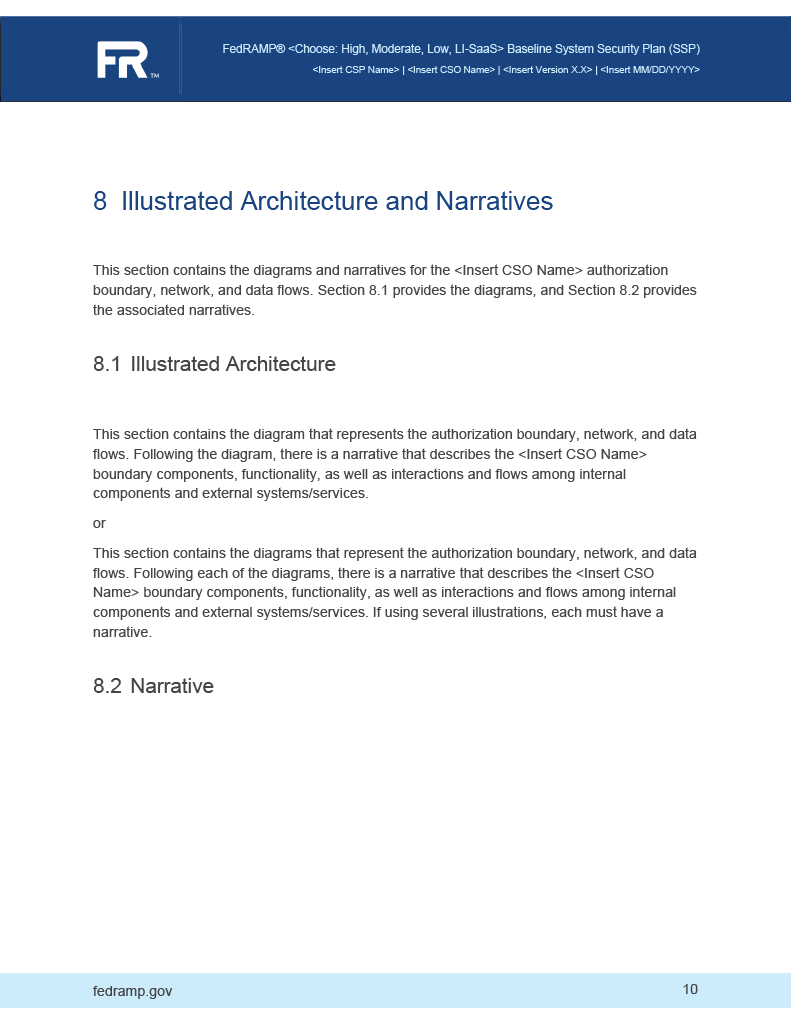
The Architecture, Network and Data Flow Diagramss are each represented using the same OSCAL patterns, with only the top level assemby name changing.
### Authorization Boundary
The OSCAL approach to this type of diagram is to treat the image data as either a linked or base64-encoded `resource` in the `back-matter` section of the OSCAL file, then reference the diagram using the `link` field. The narrative describing the system architecture must be provided in the `description` field of the `authorization-boundary` assembly.
 #### OSCAL Representation
```yaml
system-security-plan:
uuid: 11111111-2222-4000-8000-000000000000
system-characteristics:
authorization-boundary:
description: A holistic, top-level explanation of the FedRAMP authorization boundary.
diagrams:
- uuid: 11111111-2222-4000-8000-007000000001
description: A diagram-specific explanation.
links:
- href: '#11111111-2222-4000-8000-001000000054'
rel: diagram
caption: Authorization Boundary Diagram
back-matter:
resources:
- uuid: 11111111-2222-4000-8000-001000000054
title: Boundary Diagram
description: The primary authorization boundary diagram.
props:
- name: type
value: image
class: authorization-boundary
rlinks:
- href: ./attachments/diagrams/boundary.png
```
To represent the **Authorization Boundary** from the legacy SSP in an OSCAL-based System Security Plan, the data is centered within the `system-characteristics` section under the `authorization-boundary` element.
The following elements and structures are used to capture the boundary definition:
* **Boundary Narrative:** An `overall-description` is used to provide a high-level technical and functional summary of the system's limits.
* **Visual Documentation:** The model tracks the total number of boundary diagrams present to ensure compliance with the minimum requirement of at least one visual representation.
* **Diagram Linking:** Each diagram is referenced via a `link` containing a unique identifier or path. This link either points to an external URI or a local reference within the OSCAL document.
* **Resource Storage:** The actual image data or file location for a diagram is stored in the `back-matter` section. This is handled as a `resource` which can either contain the raw `base64` encoded image data or a remote link (`rlink`) to the hosted file.
* **Contextual Details:** Individual diagrams can also include their own specific `description` to clarify the components, data flows, or sub-networks depicted in that particular view.
When multiple diagrams are required to show different perspectives of the boundary, each is listed as a sequential entry within the authorization boundary array.
---
### Network Architecture
The network architecture diagram follows the same patter as the [*Authorization Boundary*](#authorization-boundary) diagram, except the content is placed under `network-architecture` instead of `authorization-boundary`.
#### OSCAL Representation
```yaml
system-security-plan:
uuid: 11111111-2222-4000-8000-000000000000
system-characteristics:
network-architecture:
description: A holistic, top-level explanation of the network architecture.
diagrams:
- uuid: 11111111-2222-4000-8000-007000000002
description: A diagram-specific explanation.
links:
- href: '#11111111-2222-4000-8000-001000000055'
rel: diagram
caption: Network Diagram
back-matter:
resources:
- uuid: 11111111-2222-4000-8000-001000000055
title: Network Diagram
description: The primary network diagram.
props:
- name: type
value: image
class: network-architecture
rlinks:
- href: ./attachments/diagrams/network.png
```
---
### Data Flow
The data flow diagram follows the same pattern as the [*Authorization Boundary*](#authorization-boundary) diagram, except the content is placed under `data-flow` instead of `authorization-boundary`.
#### OSCAL Representation
```yaml
system-security-plan:
uuid: 11111111-2222-4000-8000-000000000000
system-characteristics:
data-flow:
description: A holistic, top-level explanation of the system's data flows.
diagrams:
- uuid: 11111111-2222-4000-8000-007000000003
description: A diagram-specific explanation.
links:
- href: '#11111111-2222-4000-8000-001000000056'
rel: diagram
caption: Data Flow Diagram
back-matter:
resources:
- uuid: 11111111-2222-4000-8000-001000000056
title: Data Flow Diagram
description: The primary data flow diagram.
props:
- name: type
value: image
class: data-flow
rlinks:
- href: ./attachments/diagrams/dataflow.png
```
# 9. Services, Ports and Protocols
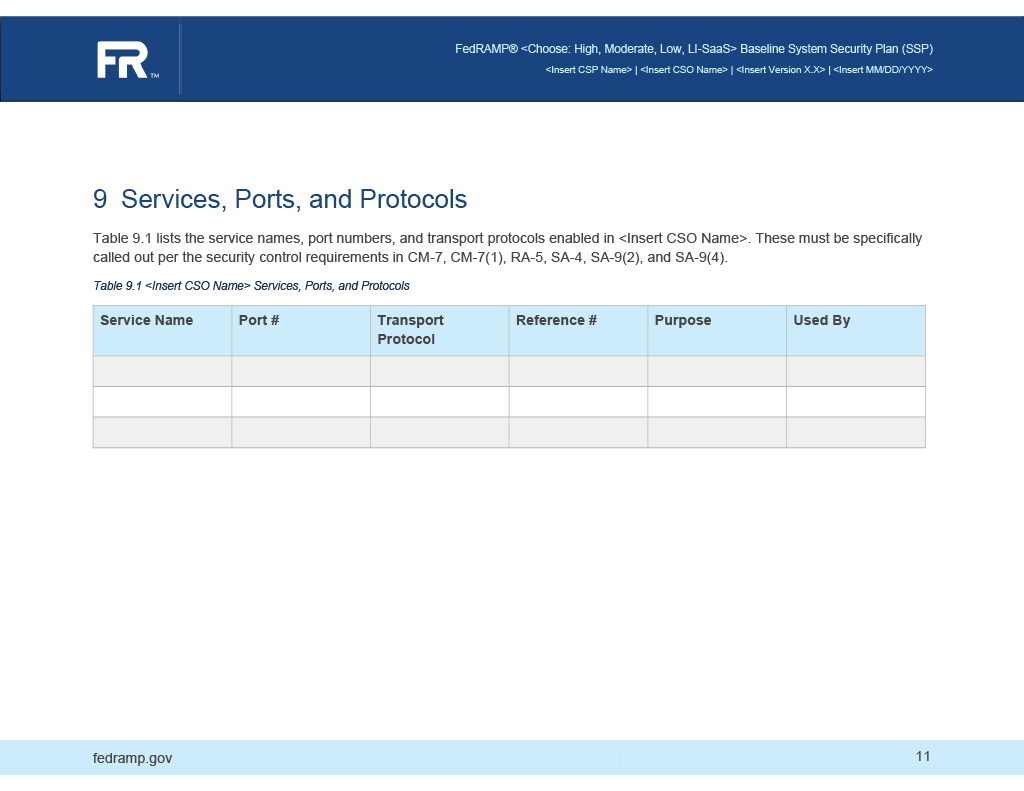
Entries in the services, ports, and protocols table are represented as component assemblies, with the component-type flag set to "service". Use a protocol assembly for each protocol associated with the service. For a single port, set the port-range start flag and end flag to the same value.
#### OSCAL Representation
```yaml
system-security-plan:
uuid: 11111111-2222-4000-8000-000000000000
system-characteristics:
authorization-boundary:
description: A holistic, top-level explanation of the FedRAMP authorization boundary.
diagrams:
- uuid: 11111111-2222-4000-8000-007000000001
description: A diagram-specific explanation.
links:
- href: '#11111111-2222-4000-8000-001000000054'
rel: diagram
caption: Authorization Boundary Diagram
back-matter:
resources:
- uuid: 11111111-2222-4000-8000-001000000054
title: Boundary Diagram
description: The primary authorization boundary diagram.
props:
- name: type
value: image
class: authorization-boundary
rlinks:
- href: ./attachments/diagrams/boundary.png
```
To represent the **Authorization Boundary** from the legacy SSP in an OSCAL-based System Security Plan, the data is centered within the `system-characteristics` section under the `authorization-boundary` element.
The following elements and structures are used to capture the boundary definition:
* **Boundary Narrative:** An `overall-description` is used to provide a high-level technical and functional summary of the system's limits.
* **Visual Documentation:** The model tracks the total number of boundary diagrams present to ensure compliance with the minimum requirement of at least one visual representation.
* **Diagram Linking:** Each diagram is referenced via a `link` containing a unique identifier or path. This link either points to an external URI or a local reference within the OSCAL document.
* **Resource Storage:** The actual image data or file location for a diagram is stored in the `back-matter` section. This is handled as a `resource` which can either contain the raw `base64` encoded image data or a remote link (`rlink`) to the hosted file.
* **Contextual Details:** Individual diagrams can also include their own specific `description` to clarify the components, data flows, or sub-networks depicted in that particular view.
When multiple diagrams are required to show different perspectives of the boundary, each is listed as a sequential entry within the authorization boundary array.
---
### Network Architecture
The network architecture diagram follows the same patter as the [*Authorization Boundary*](#authorization-boundary) diagram, except the content is placed under `network-architecture` instead of `authorization-boundary`.
#### OSCAL Representation
```yaml
system-security-plan:
uuid: 11111111-2222-4000-8000-000000000000
system-characteristics:
network-architecture:
description: A holistic, top-level explanation of the network architecture.
diagrams:
- uuid: 11111111-2222-4000-8000-007000000002
description: A diagram-specific explanation.
links:
- href: '#11111111-2222-4000-8000-001000000055'
rel: diagram
caption: Network Diagram
back-matter:
resources:
- uuid: 11111111-2222-4000-8000-001000000055
title: Network Diagram
description: The primary network diagram.
props:
- name: type
value: image
class: network-architecture
rlinks:
- href: ./attachments/diagrams/network.png
```
---
### Data Flow
The data flow diagram follows the same pattern as the [*Authorization Boundary*](#authorization-boundary) diagram, except the content is placed under `data-flow` instead of `authorization-boundary`.
#### OSCAL Representation
```yaml
system-security-plan:
uuid: 11111111-2222-4000-8000-000000000000
system-characteristics:
data-flow:
description: A holistic, top-level explanation of the system's data flows.
diagrams:
- uuid: 11111111-2222-4000-8000-007000000003
description: A diagram-specific explanation.
links:
- href: '#11111111-2222-4000-8000-001000000056'
rel: diagram
caption: Data Flow Diagram
back-matter:
resources:
- uuid: 11111111-2222-4000-8000-001000000056
title: Data Flow Diagram
description: The primary data flow diagram.
props:
- name: type
value: image
class: data-flow
rlinks:
- href: ./attachments/diagrams/dataflow.png
```
# 9. Services, Ports and Protocols
Entries in the services, ports, and protocols table are represented as component assemblies, with the component-type flag set to "service". Use a protocol assembly for each protocol associated with the service. For a single port, set the port-range start flag and end flag to the same value.
 #### OSCAL Representation
```yaml
system-security-plan:
uuid: 11111111-2222-4000-8000-000000000000
system-implementation:
components:
- uuid: 11111111-2222-4000-8000-009000500004
type: service
title: API Service
description: 'A service offered by this system to external systems, such as
an API. As a result, communication crosses the boundary.
Describe the service and what it is used for.'
props:
- name: implementation-point
value: internal
- name: public
value: 'yes'
- name: information-type
ns: http://fedramp.gov/ns/oscal
value: C.3.5.1
class: incoming
- name: information-type
ns: http://fedramp.gov/ns/oscal
value: C.3.5.8
class: outgoing
- name: connection-security
ns: http://fedramp.gov/ns/oscal
value: tls-1.3
- name: authentication-method
ns: http://fedramp.gov/ns/oscal
value: 'yes'
- name: nature-of-agreement
ns: http://fedramp.gov/ns/oscal
value: other
- name: allows-authenticated-scan
value: 'no'
- name: scan-type
ns: http://fedramp.gov/ns/oscal
value: infrastructure
links:
- href: '#11111111-2222-4000-8000-009000100003'
rel: used-by
- href: '#11111111-2222-4000-8000-009000100004'
rel: used-by
- href: '#11111111-2222-4000-8000-001000000048'
rel: poam-item
resource-fragment: 11111111-3333-4000-8000-000000000004
- href: https://api.example.com/v1
rel: api
status:
state: operational
responsible-roles:
- role-id: administrator
props:
- name: privilege-uuid
ns: http://fedramp.gov/ns/oscal
value: 11111111-2222-4000-8000-008000000004
party-uuids:
- 11111111-2222-4000-8000-004000000010
- 11111111-2222-4000-8000-004000000011
- 11111111-2222-4000-8000-004000000012
- role-id: provider
party-uuids:
- 11111111-2222-4000-8000-004000000001
protocols:
- uuid: 11111111-2222-4000-8000-010000000002
name: tls
title: API Service
port-ranges:
- start: '443'
end: '443'
transport: TCP
```
To represent **Network Services and Ports** within an OSCAL System Security Plan, the data is organized under the `system-implementation` section, specifically categorized by components where the `type` is defined as `service`, `hardware` or `software`.
The mapping for each service entry includes the following technical details:
* **Service Identity:** Each entry starts with a `title` that identifies the specific service or application name (e.g., "HTTPS" or "SSH").
* **Protocol Configuration:** The specific network `protocol` name (such as TCP or UDP) is identified to define how the service communicates.
* **Port Management:** Detailed port information is captured within a `port-range`, specifying the exact `start` and `end` values. This also includes the `transport` layer designation to ensure the specific communication path is fully defined.
* **Functional Justification:** A dedicated `purpose` field provides the business or technical rationale for why the service is required within the system boundary.
* **Component Relationships:** The model tracks which internal system elements are utilizing the service by linking to the `title` of other defined components via their unique identifiers (UUIDs).
For systems with multiple services, each is documented as an individual service component, with the ability to define multiple protocols and port ranges within each entry to maintain a complete and granular inventory.
---
# 10. Cryptographic Modules Implemented for DAR and DIT
#### OSCAL Representation
```yaml
system-security-plan:
uuid: 11111111-2222-4000-8000-000000000000
system-implementation:
components:
- uuid: 11111111-2222-4000-8000-009000500004
type: service
title: API Service
description: 'A service offered by this system to external systems, such as
an API. As a result, communication crosses the boundary.
Describe the service and what it is used for.'
props:
- name: implementation-point
value: internal
- name: public
value: 'yes'
- name: information-type
ns: http://fedramp.gov/ns/oscal
value: C.3.5.1
class: incoming
- name: information-type
ns: http://fedramp.gov/ns/oscal
value: C.3.5.8
class: outgoing
- name: connection-security
ns: http://fedramp.gov/ns/oscal
value: tls-1.3
- name: authentication-method
ns: http://fedramp.gov/ns/oscal
value: 'yes'
- name: nature-of-agreement
ns: http://fedramp.gov/ns/oscal
value: other
- name: allows-authenticated-scan
value: 'no'
- name: scan-type
ns: http://fedramp.gov/ns/oscal
value: infrastructure
links:
- href: '#11111111-2222-4000-8000-009000100003'
rel: used-by
- href: '#11111111-2222-4000-8000-009000100004'
rel: used-by
- href: '#11111111-2222-4000-8000-001000000048'
rel: poam-item
resource-fragment: 11111111-3333-4000-8000-000000000004
- href: https://api.example.com/v1
rel: api
status:
state: operational
responsible-roles:
- role-id: administrator
props:
- name: privilege-uuid
ns: http://fedramp.gov/ns/oscal
value: 11111111-2222-4000-8000-008000000004
party-uuids:
- 11111111-2222-4000-8000-004000000010
- 11111111-2222-4000-8000-004000000011
- 11111111-2222-4000-8000-004000000012
- role-id: provider
party-uuids:
- 11111111-2222-4000-8000-004000000001
protocols:
- uuid: 11111111-2222-4000-8000-010000000002
name: tls
title: API Service
port-ranges:
- start: '443'
end: '443'
transport: TCP
```
To represent **Network Services and Ports** within an OSCAL System Security Plan, the data is organized under the `system-implementation` section, specifically categorized by components where the `type` is defined as `service`, `hardware` or `software`.
The mapping for each service entry includes the following technical details:
* **Service Identity:** Each entry starts with a `title` that identifies the specific service or application name (e.g., "HTTPS" or "SSH").
* **Protocol Configuration:** The specific network `protocol` name (such as TCP or UDP) is identified to define how the service communicates.
* **Port Management:** Detailed port information is captured within a `port-range`, specifying the exact `start` and `end` values. This also includes the `transport` layer designation to ensure the specific communication path is fully defined.
* **Functional Justification:** A dedicated `purpose` field provides the business or technical rationale for why the service is required within the system boundary.
* **Component Relationships:** The model tracks which internal system elements are utilizing the service by linking to the `title` of other defined components via their unique identifiers (UUIDs).
For systems with multiple services, each is documented as an individual service component, with the ability to define multiple protocols and port ranges within each entry to maintain a complete and granular inventory.
---
# 10. Cryptographic Modules Implemented for DAR and DIT
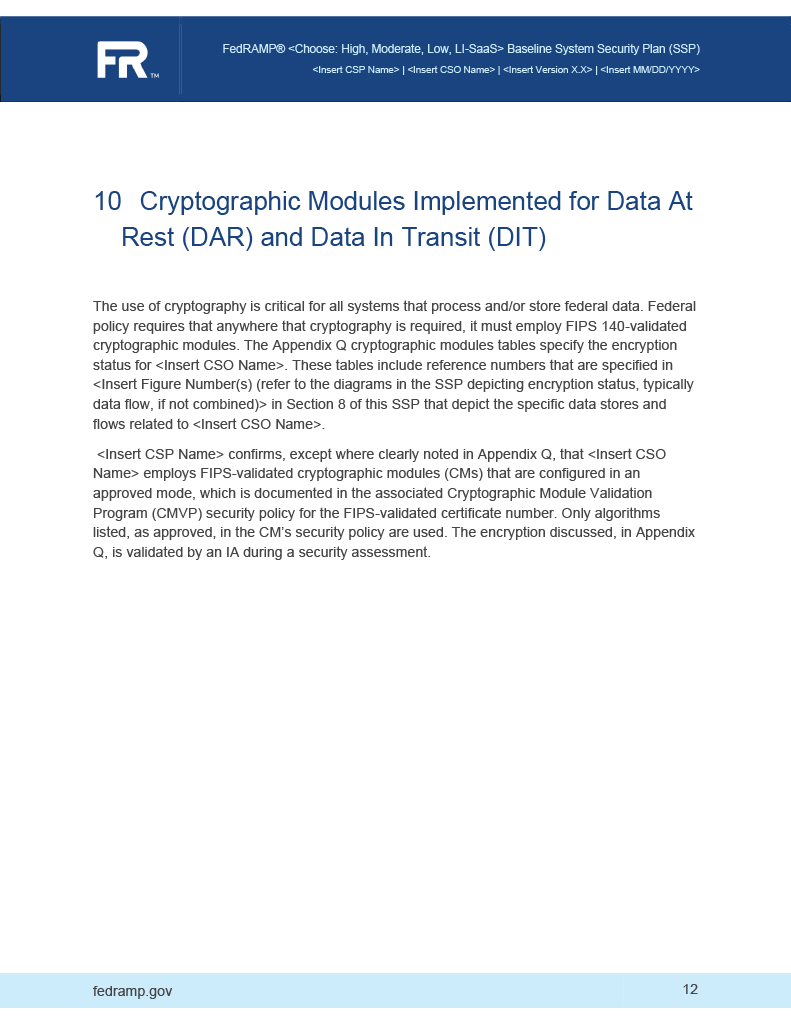 This is address in [Appendix Q: Cryptographic Modules](/books/3-fedramp-system-security-plan-ssp/page/appendix-q-cryptographic-modules).
# 11. Seperation of Duties Matrix
This is address in [Appendix Q: Cryptographic Modules](/books/3-fedramp-system-security-plan-ssp/page/appendix-q-cryptographic-modules).
# 11. Seperation of Duties Matrix
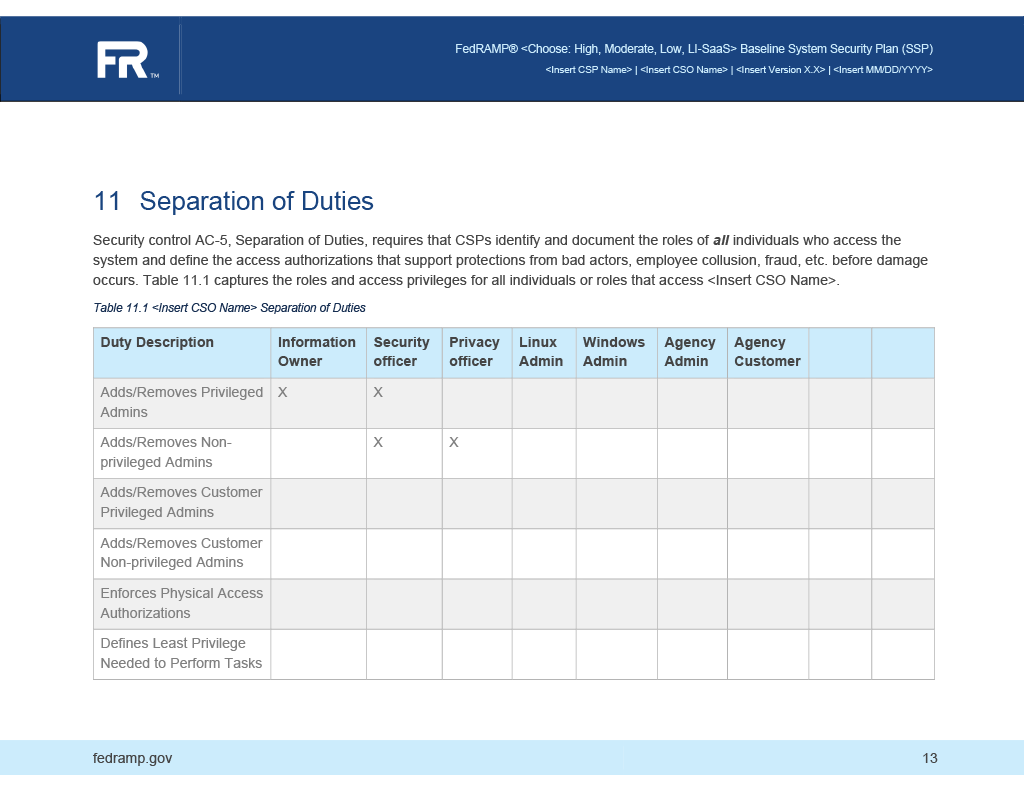 The `metadata` / `roles` array must have one entry for each column
- an `id` with a token (use pre-defined ID values whenever possible)
- a `title` with a human-readable role name
The `system-implementation` / `users` array must have one entry for each row:
- a `uuid` (required)
- a `props` array with the following entry:
- a `name` with `separation-of-duties-matrix`
- a `ns` with `http://fedramp.gov/ns/oscal`
- a `value` with `yes`
- a `role-ids` array with each entry:
- the role ID token defined in `metadata` / `roles`
- Only for roles where an "X" would appear in the table
- an `authorized-privileges` array with one or more entries:
- a `title` with the text from the "Duty Description" column
- a `functions-performed` array with at least one string entry describing the function. (This is an OSCAL required field that is not required by FedRAMP.)
```yaml
system-security-plan:
metadata:
roles:
- id: asset-administrator
title: Asset Administrator
- id: admin-client
title: Customer-Designated Administrator
- id: admin-unix
title: Unix Administrator
system-implementation:
users:
- uuid: 11111111-2222-4000-8000-008000000002
props:
- name: separation-of-duties-matrix
ns: http://fedramp.gov/ns/oscal
value: 'yes'
role-ids:
- asset-administrator
authorized-privileges:
- title: Add/Remove Admins
functions-performed:
- This can add and remove admins.
- uuid: 11111111-2222-4000-8000-008000000003
props:
- name: separation-of-duties-matrix
ns: http://fedramp.gov/ns/oscal
value: 'yes'
role-ids:
- asset-administrator
- admin-client
authorized-privileges:
- title: Add/Remove Users
functions-performed:
- add/remove non-privliged users
- uuid: 11111111-2222-4000-8000-008000000004
props:
- name: separation-of-duties-matrix
ns: http://fedramp.gov/ns/oscal
value: 'yes'
role-ids:
- asset-administrator
authorized-privileges:
- title: Cloud-Native Service Deployment
functions-performed:
- Manage services and components within the virtual cloud environment.
- uuid: 11111111-2222-4000-8000-008000000005
props:
- name: separation-of-duties-matrix
ns: http://fedramp.gov/ns/oscal
value: 'yes'
role-ids:
- admin-client
authorized-privileges:
- title: Application User Admin
functions-performed:
- Add and remove users from the virtual cloud environment.
```
The `metadata` / `roles` array must have one entry for each column
- an `id` with a token (use pre-defined ID values whenever possible)
- a `title` with a human-readable role name
The `system-implementation` / `users` array must have one entry for each row:
- a `uuid` (required)
- a `props` array with the following entry:
- a `name` with `separation-of-duties-matrix`
- a `ns` with `http://fedramp.gov/ns/oscal`
- a `value` with `yes`
- a `role-ids` array with each entry:
- the role ID token defined in `metadata` / `roles`
- Only for roles where an "X" would appear in the table
- an `authorized-privileges` array with one or more entries:
- a `title` with the text from the "Duty Description" column
- a `functions-performed` array with at least one string entry describing the function. (This is an OSCAL required field that is not required by FedRAMP.)
```yaml
system-security-plan:
metadata:
roles:
- id: asset-administrator
title: Asset Administrator
- id: admin-client
title: Customer-Designated Administrator
- id: admin-unix
title: Unix Administrator
system-implementation:
users:
- uuid: 11111111-2222-4000-8000-008000000002
props:
- name: separation-of-duties-matrix
ns: http://fedramp.gov/ns/oscal
value: 'yes'
role-ids:
- asset-administrator
authorized-privileges:
- title: Add/Remove Admins
functions-performed:
- This can add and remove admins.
- uuid: 11111111-2222-4000-8000-008000000003
props:
- name: separation-of-duties-matrix
ns: http://fedramp.gov/ns/oscal
value: 'yes'
role-ids:
- asset-administrator
- admin-client
authorized-privileges:
- title: Add/Remove Users
functions-performed:
- add/remove non-privliged users
- uuid: 11111111-2222-4000-8000-008000000004
props:
- name: separation-of-duties-matrix
ns: http://fedramp.gov/ns/oscal
value: 'yes'
role-ids:
- asset-administrator
authorized-privileges:
- title: Cloud-Native Service Deployment
functions-performed:
- Manage services and components within the virtual cloud environment.
- uuid: 11111111-2222-4000-8000-008000000005
props:
- name: separation-of-duties-matrix
ns: http://fedramp.gov/ns/oscal
value: 'yes'
role-ids:
- admin-client
authorized-privileges:
- title: Application User Admin
functions-performed:
- Add and remove users from the virtual cloud environment.
```
**The `props` entry is required in each `users` entry.** It identifies which `users` array entries are intended to represent the Separation of Duties Matrix. Tools processing OSCAL SSPs only for FedRAMP should ignore any `users` entry that does not include this `props` entry.