# 3. System Information
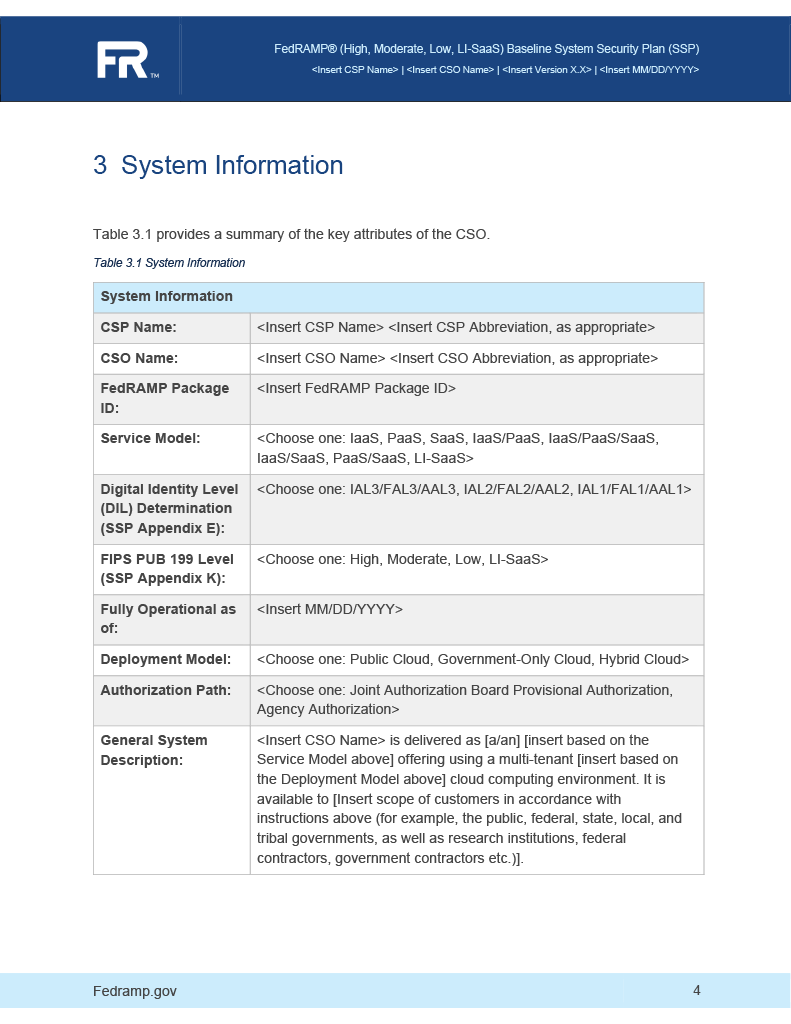 ## System Information
### CSP Name
The cloud service provider (CSP) name and abbreviation are represented in the SSP `metadata`.
- A `roles` extry must exist with `id` = `cloud-service-provider`
- A `parties` entry must exist with the CSP's `name` and `short-name`.
- A `responsible-parties` entry must exist to link the `parties` UUID value to the `cloud-service-provider` role.
#### OSCAL Representation
```yaml
system-security-plan:
uuid: 11111111-2222-4000-8000-000000000000
metadata:
roles:
- id: cloud-service-provider
title: Cloud Service Provider
short-name: CSP
parties:
- uuid: 11111111-2222-4000-8000-004000000001
type: organization
name: Cloud Service Provider (CSP) Name
short-name: CSP Acronym/Short Name
responsible-parties:
- role-id: cloud-service-provider
party-uuids:
- 11111111-2222-4000-8000-004000000001
```
---
### CSO Name
The CSO name and abbreviation are represented in `system-characteristics`.
- The `system-name` field contains the CSO Name
- The `system-name-short` field contains the CSO abbreviation.
#### OSCAL Representation
```yaml
system-security-plan:
system-characteristics:
system-name: System's Full Name
system-name-short: System's Short Name or Acronym
system-ids:
- identifier-type: http://fedramp.gov/ns/oscal
id: F00000000
```
---
### FedRAMP Package ID
The FedRAMP Package ID is represented in `system-characteristics`.
- A `system-ids` entry must exist that includes:
- `identifier-type` set to `http://fedramp.gov/ns/oscal`
- `id` set to the FedRAMP Package ID
#### OSCAL Representation
```yaml
system-security-plan:
system-characteristics:
system-ids:
- identifier-type: http://fedramp.gov/ns/oscal
id: F00000000
```
## System Information
### CSP Name
The cloud service provider (CSP) name and abbreviation are represented in the SSP `metadata`.
- A `roles` extry must exist with `id` = `cloud-service-provider`
- A `parties` entry must exist with the CSP's `name` and `short-name`.
- A `responsible-parties` entry must exist to link the `parties` UUID value to the `cloud-service-provider` role.
#### OSCAL Representation
```yaml
system-security-plan:
uuid: 11111111-2222-4000-8000-000000000000
metadata:
roles:
- id: cloud-service-provider
title: Cloud Service Provider
short-name: CSP
parties:
- uuid: 11111111-2222-4000-8000-004000000001
type: organization
name: Cloud Service Provider (CSP) Name
short-name: CSP Acronym/Short Name
responsible-parties:
- role-id: cloud-service-provider
party-uuids:
- 11111111-2222-4000-8000-004000000001
```
---
### CSO Name
The CSO name and abbreviation are represented in `system-characteristics`.
- The `system-name` field contains the CSO Name
- The `system-name-short` field contains the CSO abbreviation.
#### OSCAL Representation
```yaml
system-security-plan:
system-characteristics:
system-name: System's Full Name
system-name-short: System's Short Name or Acronym
system-ids:
- identifier-type: http://fedramp.gov/ns/oscal
id: F00000000
```
---
### FedRAMP Package ID
The FedRAMP Package ID is represented in `system-characteristics`.
- A `system-ids` entry must exist that includes:
- `identifier-type` set to `http://fedramp.gov/ns/oscal`
- `id` set to the FedRAMP Package ID
#### OSCAL Representation
```yaml
system-security-plan:
system-characteristics:
system-ids:
- identifier-type: http://fedramp.gov/ns/oscal
id: F00000000
```
**FedRAMP Allowed Value**
Required Identifier Type:
- identifier-type="https://fedramp.gov"
---
### Service Model
The Service Model is represented in `system-characteristics`.
- A `system-characteristics` property (`prop`) entry must exist that includes:
- A `name` set to `cloud-service-model`
- A `value` set to one of the allowed service model values below.
- If the `value` is set to `other`, `remarks` is used to explain.
If more than one service model type is applicable (IaaS and PaaS; IaaS and PaaS and SaaS; PaaS and SaaS), use one "cloud-service-model" prop for _each_ applicable cloud service model.
#### OSCAL Representation
```yaml
system-security-plan:
system-characteristics:
props:
- name: cloud-service-model
value: iaas
- name: cloud-service-model
value: paas
- name: cloud-service-model
value: other
remarks: Remarks are required if service model is "other". Optional otherwise.
```
**OSCAL Allowed Values**
Valid `cloud-service-model` property values:
- `saas`
- `paas`
- `iaas`
- `other`
---
### Digital Identity Level (DIL) Determination
See [Appendix E](https://patterns.rufrisk.com/books/fedramp-system-security-plan-ssp/page/appendix-e-digital-identity-level-dil-determination) for appropriate OSCAL representation.
---
### FIPS PUB 199 Level
See [Appendix K](https://patterns.rufrisk.com/books/fedramp-system-security-plan-ssp/page/appendix-k-fips-199-worksheet) for appropriate OSCAL representation.
---
### Fully Operational as of
The fully operational date is represented in `system-characteristics`.
- A `system-characteristics` property (`prop`) entry must exist that includes:
- A `name` set to `fully-operational-date`
- A `ns` set to `http://fedramp.gov/ns/oscal`
- A `value` set to the operational date.
Although the `value` field is a string, the date should be treated as an OSCAL [date-time-with-timezone](https://pages.nist.gov/metaschema/specification/datatypes/#date-time-with-timezone) data type.
#### OSCAL Representation
```yaml
system-security-plan:
system-characteristics:
props:
- name: fully-operational-date
ns: http://fedramp.gov/ns/oscal
value: '2023-12-31T00:00:00Z'
```
---
### Deployment Model
The Deployment Model is represented in `system-characteristics`.
- A `system-characteristics` property (`prop`) entry must exist that includes:
- A `name` set to `deployment-model`
- A `value` set to one of the allowed deployment model values below.
- If the `value` is set to `other`, `remarks` is used to explain.
- Only one `cloud-deployment-model` property is permitted.
If the deployment model is `hybrid` or `other`, the remarks field is required. Otherwise, it is optional.
#### OSCAL Representation
```yaml
system-security-plan:
system-characteristics:
props:
- name: cloud-deployment-model
value: hybrid-cloud
remarks: Remarks are required if deployment model is "hybrid-cloud" or "other". Optional otherwise.
```
**FedRAMP Accepted Values**
Valid `cloud-deployment-model` property values:
- `public-cloud`
- `private-cloud`
- `government-only-cloud`
- `hybrid-cloud`
- `other`
Although core OSCAL also allows `community-cloud`, FedRAMP authorizations do not include community clouds.
---
### Authorization Path
This is an obsolete concept and does not need to be represented in OSCAL.
---
### General System Description
The General System Description is represented in `system-characteristics`.
- The `description` field contains the general system description.
- This is a [markup-multiline](https://pages.nist.gov/metaschema/specification/datatypes/#markup-multiline) field.
#### OSCAL Representation
```yaml
system-security-plan:
system-characteristics:
description: '\[Insert CSO Name\] is delivered as \[a/an\] \[insert based on the Service Model above\] offering using a multi-tenant \[insert based on the Deployment Model above\] cloud computing environment. It is available to \[Insert scope of customers in accordance with instructions above (for example, the public, federal, state, local, and tribal governments, as well as research institutions, federal contractors, government contractors etc.)\].'
```