# Control Implementation Statements
Typically, the controls in the FedRAMP baselines have lettered parts (a., b., etc.). A few only have a top-level statement with no parts. Current FedRAMP templates expect responses at the lettered part level when present and at the top-level otherwise.
OSCAL SSPs cite controls and control requirement statements in responses.
Within the OSCAL FedRAMP baselines, each control statement is assigned an identifier. Any lettered parts are also assigned identifiers.
Citing statement identifiers correctly is critical to automated processing.
See [Citing Control Statements](https://patterns.rufrisk.com/books/fedramp-system-security-plan-ssp/page/citing-control-statements) for important information.
### Typical
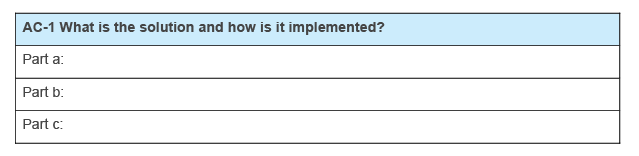 Most FedRAMP controls have two or more lettered parts. FedRAMP expects control responses at this level.
Within the `control-implementation` / `implemented-requirements` array, each entry includes:
- a required `uuid` field
- a required `control-id` field that cites the control [using its id from the baseline](https://patterns.rufrisk.com/books/fedramp-system-security-plan-ssp/page/citing-control-statements).
- a required `statements` array. Each array entry includes:
- a `statement-id` field that cites the control statement [using its id from the baseline](https://patterns.rufrisk.com/books/fedramp-system-security-plan-ssp/page/citing-control-statements).
- a `by-components` array
- See [Responding By Component](https://patterns.rufrisk.com/books/fedramp-system-security-plan-ssp/page/responding-by-component) for more information.
##### Multi-Part Statement Representation
```yaml
system-security-plan:
control-implementation:
implemented-requirements:
- uuid: 11111111-2222-4000-8000-012000010000
control-id: ac-1
statements:
- statement-id: ac-1_smt.a
uuid: 11111111-2222-4000-8000-012000010100
by-components:
[content cut]
```
---
### Non-Typical
If there are no lettered parts in the control definition, such as with
AC-2 (1), there must be exactly one statement assembly.
##### Single-Statement Representation
[](https://patterns.rufrisk.com/uploads/images/gallery/2026-04/ssp-control-response-1-crop.png)
A single-statement representation is identical to a typical multi-part statement representation, except for the following:
- there is only one entry in the `statements` array
- the `statement-id` value cites the baseline ID for the `statement` part itself instead of one of its child parts.
```yaml
system-security-plan:
control-implementation:
implemented-requirements:
- uuid: 11111111-2222-4000-8000-012000010000
control-id: ac-2.1
statements:
- statement-id: ac-2.1_smt
uuid: 11111111-2222-4000-8000-012000010100
by-components:
[content cut]
```
---
Most FedRAMP controls have two or more lettered parts. FedRAMP expects control responses at this level.
Within the `control-implementation` / `implemented-requirements` array, each entry includes:
- a required `uuid` field
- a required `control-id` field that cites the control [using its id from the baseline](https://patterns.rufrisk.com/books/fedramp-system-security-plan-ssp/page/citing-control-statements).
- a required `statements` array. Each array entry includes:
- a `statement-id` field that cites the control statement [using its id from the baseline](https://patterns.rufrisk.com/books/fedramp-system-security-plan-ssp/page/citing-control-statements).
- a `by-components` array
- See [Responding By Component](https://patterns.rufrisk.com/books/fedramp-system-security-plan-ssp/page/responding-by-component) for more information.
##### Multi-Part Statement Representation
```yaml
system-security-plan:
control-implementation:
implemented-requirements:
- uuid: 11111111-2222-4000-8000-012000010000
control-id: ac-1
statements:
- statement-id: ac-1_smt.a
uuid: 11111111-2222-4000-8000-012000010100
by-components:
[content cut]
```
---
### Non-Typical
If there are no lettered parts in the control definition, such as with
AC-2 (1), there must be exactly one statement assembly.
##### Single-Statement Representation
[](https://patterns.rufrisk.com/uploads/images/gallery/2026-04/ssp-control-response-1-crop.png)
A single-statement representation is identical to a typical multi-part statement representation, except for the following:
- there is only one entry in the `statements` array
- the `statement-id` value cites the baseline ID for the `statement` part itself instead of one of its child parts.
```yaml
system-security-plan:
control-implementation:
implemented-requirements:
- uuid: 11111111-2222-4000-8000-012000010000
control-id: ac-2.1
statements:
- statement-id: ac-2.1_smt
uuid: 11111111-2222-4000-8000-012000010100
by-components:
[content cut]
```
---