# Retrofit Adoption Path
If you need to convert legacy documentation to OSCAL, follow this path.
If you are approaching OSCAL to intially create your system security plan and do not have legacy documentation to convert, follow the [Native Adoption Path](https://patterns.rufrisk.com/books/fedramp-system-security-plan-ssp/page/native-adoption-path).
---
Organizations with existing Word and Excel based authorization packages must first migrate their content to OSCAL with only the minimum necessary refactoring. The _Retrofit Adoption Path_ starts with a minimum viable product (MVP) and evolves to more comprehensive use cases in phases.
This approach initially sacrifices data normalization in favor of a more rapid transition to OSCAL. It allows conversion of content as-is, then gradually eliminates redundancy and normalizes data in subsequent phases. This is possible because OSCAL is designed to meet you where you are, and it allows gradual progress toward its more normalized ideal representation.
## SSP Retrofit Adoption Overview
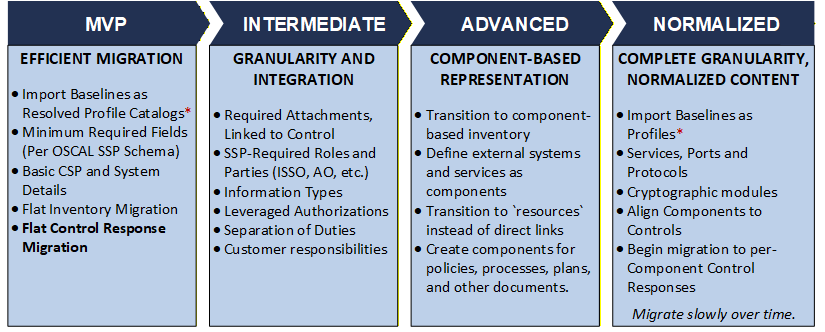
The OSCAL Foundation recommends the following addoption path for migrating legacy FedRAMP SSP content to OSCAL.
[](https://patterns.rufrisk.com/uploads/images/gallery/2026-04/retro-adoption-path.png)
To facilitate conversion of legacy Word content, OSCAL allows legacy control responses to be associated with the "this-system" component. CSPs can migrate slowly over time to the OSCAL's preferred per-component responses.
---
## SSP Adoption Path
#### MINIMUM VIABLE PRODUCT (MVP)
- **Import Baselines as _Resolved Profile Catalogs_**
- Get started with Use pre-processed control baselines.
- See [Baselines](https://patterns.rufrisk.com/books/supporting-resources-and-valid-content/page/baselines) for more information.
- **Minimum Required Fieldss and Basic CSP and System Details.**
- **`metadata`** includes:
- `title`, `published`, `last-modified`, `version`, `oscal-version`
- `roles`: `cloud-service-provider`, `information-system-security-officer`, others as cited in controls.
- See _[Roles](https://patterns.rufrisk.com/books/fedramp-common/page/roles)_ for more information on roles.
- `parties`: the CSP, the ISSO.
- See _[Parties and Locations](https://patterns.rufrisk.com/books/fedramp-common/page/parties-and-locations)_ for more information on defining parties.
- `responsible-parties`: exactly one, linking the CSP party to the CSP role
- See _[Roles](https://patterns.rufrisk.com/books/fedramp-common/page/roles)_ for more information on associating parties with roles.
- **`system-characteristics`** includes:
- `system-id`, `system-name`, `system-name-short`, `description`, _cloud-service-model_ `prop` and _cloud-deployment-model_ `prop`
- See _[3. System Information](https://patterns.rufrisk.com/books/fedramp-system-security-plan-ssp/page/3-system-information)_ for more information
- `security-sensitivity-level` (`fips-199-high`, `fips-199-moderate`, `fips-199-low`)
- `system-information`: exactly one entry with Appendix K pasted into the `description`
- `status` set to `operational` (required OSCAL fields)
- See _[System Status](https://patterns.rufrisk.com/books/fedramp-system-security-plan-ssp/page/system-status)_ for more information.
- `authorization-boundary`, `network-architecture` and `data-flow`: `description` and `links` entry identifying the external attachment.
- See _[8. Illustratred Architecture and Narratives](https://patterns.rufrisk.com/books/fedramp-system-security-plan-ssp/page/8-illustratred-architecture-and-narratives)_ for more information.
- **`system-implementation`** includes:
- `components:
- Exactly one, with `type`= _`this-system`_ (Known as the "this-system" component, which represents the system as a whole.)
- See _[Components](https://patterns.rufrisk.com/books/system-security-plans/page/components)_ for more information.
- **Flat Inventory Migration**
- Convert directly from spreadsheet.
- Non-normalized. No corrisponding components.
- **`system-implementation`:**
- `inventory-items`: All inventory converted from Excel spreadsheet
- **Migrate Control Response**
- Minimum-necessary adjustments for OSCAL.
- All response statements in the "this-system" component.
- `control-implementation`
- `implemented-requirement` (AC-1, AC-2, etc.)
- `set-parameters`: set parameters as needed
- `statement` (part a, part b, etc.
- `by-component` ("this system")
- `description`: Content directly from legacy Word SSP (part a, part b, etc.)
- `implementation-status`
- `responsible-roles`: One entry per role. Use `role-id`. Must match `metadata/roles/id`.
During transition, any portion of the Word SSP not yet converted to OSCAL should be attached to the OSCAL SSP content.
---
#### INTERMEDIATE
- **Required Attachments**
- Add direct `links` from the appropriate controls to identify relevant attachments
- **Required SSP Roles**
- `metadata/roles` The roles required by SSP (System owner, ISSO, AO, etc.)
- `metada/parties`: the people, teams and organizations responsible for the above roles
- `metadata/responsible-parties`: links the above `roles` and `parties`
- **Information Types**
- `system-characteristics/system-information/information-types`
- a single entry for each row in appendix K.
- **Leveraged Authorizations**
- `system-implementation/leveraged-authorizations`:
- one entry for leveraged authorization
- corrisponding `metadata/parties` entry for each
- corrisponding `system-implementation/components` for each.
- **Separation of Duties Matrix**
- `system-implementation/users`
- one entry per row in Table 11.1
- `./authorized-privilege/functions-performed`: SSP Table 11.1 Duty Description (just one entry in the array)
- `./authorized-privilege/title`: Required by OSCAL, not by FedRAMP. Recommend duplicating the `functions-performed` content.
- `role-ids`: links `metadata/roles` to `functions-performed`
- **Customer Responsibility and Inheritance**:
- Move customer responsibility statements to `//by-components/export/responsibilities`
---
#### ADAVANCED
- **Normalize Inventory**: Transition flat inventory to component-based inventory.
- Use `components` to the greatest degree practical
- `inventory-items` become implemented instances of components
- **External Systems and Services**
- `system-implementation/components` entries for each
- **Transition to `resources`**
- Where practical, use URI fragments in `links` to reference resources instead of direct links. See _[section citation and link]_ for more information.
- **Components for Required Documents**
- One for each required document (policies, procedures, plans, user guides, Rules of Behavior)
- See _[Section citation and link]_ for more information.
---
#### NORMALIZED
- **Import Baselines as Profiles**
- Eliminate reliance on _resolved profile catalogs_
- Ensure your tools have the ability to process profiles by this phase.
- Ensure consumers of your SSP are able to process profiles.
- **Services, Ports and Protocols**
- **Migrate to component-based control responses**
- Add `components` entries as needed to support normalized inventory
- Add `by-components` entries to `implemented-requirements` for each relevant component
- Add/move component-specific control responses to their associated `by-components` response.
- Migrate slowly over time.
- **Cryptographic Modules (App Q table)**
#### Profile Imports
The decision to import a _profile_ or _resolved profile catalog_ is dependent on the profile processing capability of your tools and the tools of any receiving party.
Pre-processed _resolved profile catalogs_ are a simplified way to get started; however, OSCAL tools must ultimately process profiles. Processing OSCAL profiles is the only way tools can handle control overlays and multiple frameworks.
If you elect to start with _resolved profile catalogs_, migrate to _profiles_ as soon as yoru tools and your recipients tools can perform this processing.
#### Easy Migration
Within an OSCAL SSP, migration is performed simply by changing the `import-profile` statement to reference the appropriate _profile_ instead of a _resolved profile catalog_.
---