
9. Services, Ports and Protocols
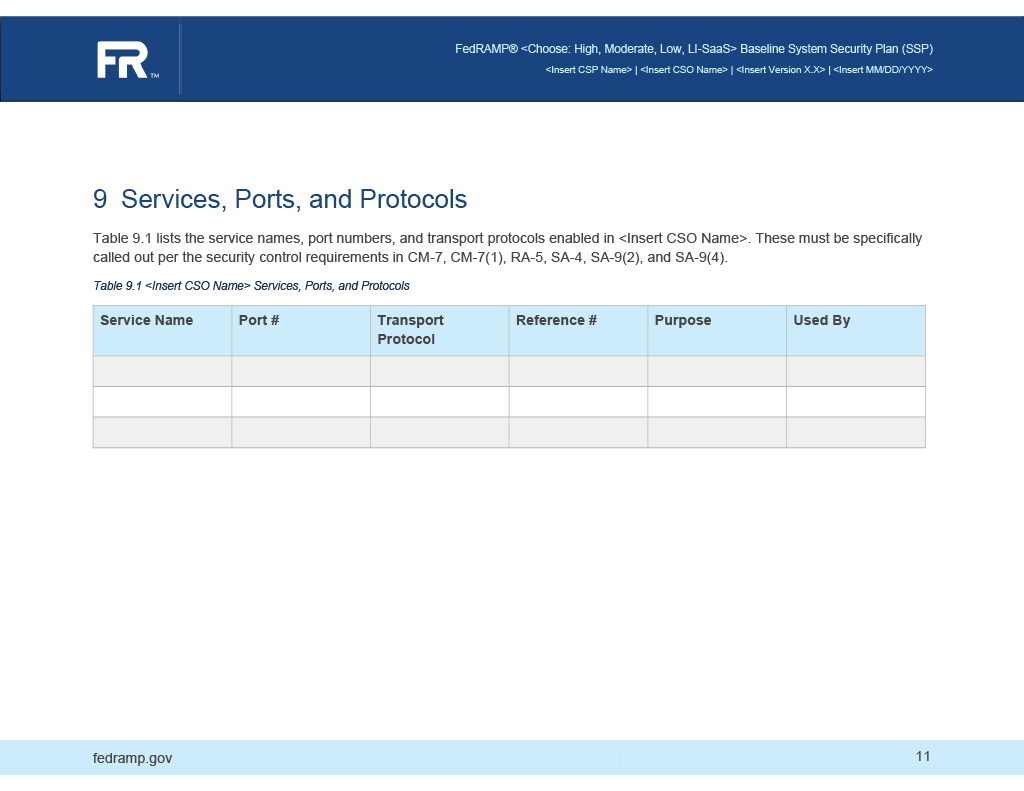
Entries in the services, ports, and protocols table are represented as component assemblies, with the component-type flag set to "service". Use a protocol assembly for each protocol associated with the service. For a single port, set the port-range start flag and end flag to the same value.
OSCAL Representation
system-security-plan:
  uuid: 11111111-2222-4000-8000-000000000000
  system-implementation:
    components:
    - uuid: 11111111-2222-4000-8000-009000500004
      type: service
      title: API Service
      description: 'A service offered by this system to external systems, such as
        an API. As a result, communication crosses the boundary.


        Describe the service and what it is used for.'
      props:
      - name: implementation-point
        value: internal
      - name: public
        value: 'yes'
      - name: information-type
        ns: http://fedramp.gov/ns/oscal
        value: C.3.5.1
        class: incoming
      - name: information-type
        ns: http://fedramp.gov/ns/oscal
        value: C.3.5.8
        class: outgoing
      - name: connection-security
        ns: http://fedramp.gov/ns/oscal
        value: tls-1.3
      - name: authentication-method
        ns: http://fedramp.gov/ns/oscal
        value: 'yes'
      - name: nature-of-agreement
        ns: http://fedramp.gov/ns/oscal
        value: other
      - name: allows-authenticated-scan
        value: 'no'
      - name: scan-type
        ns: http://fedramp.gov/ns/oscal
        value: infrastructure
      links:
      - href: '#11111111-2222-4000-8000-009000100003'
        rel: used-by
      - href: '#11111111-2222-4000-8000-009000100004'
        rel: used-by
      - href: '#11111111-2222-4000-8000-001000000048'
        rel: poam-item
        resource-fragment: 11111111-3333-4000-8000-000000000004
      - href: https://api.example.com/v1
        rel: api
      status:
        state: operational
      responsible-roles:
      - role-id: administrator
        props:
        - name: privilege-uuid
          ns: http://fedramp.gov/ns/oscal
          value: 11111111-2222-4000-8000-008000000004
        party-uuids:
        - 11111111-2222-4000-8000-004000000010
        - 11111111-2222-4000-8000-004000000011
        - 11111111-2222-4000-8000-004000000012
      - role-id: provider
        party-uuids:
        - 11111111-2222-4000-8000-004000000001
      protocols:
      - uuid: 11111111-2222-4000-8000-010000000002
        name: tls
        title: API Service
        port-ranges:
        - start: '443'
          end: '443'
          transport: TCP
To represent Network Services and Ports within an OSCAL System Security Plan, the data is organized under the system-implementation section, specifically categorized by components where the type is defined as a service.
The mapping for each service entry includes the following technical details:
- Service Identity: Each entry starts with a
titlethat identifies the specific service or application name (e.g., "HTTPS" or "SSH"). - Protocol Configuration: The specific network
protocolname (such as TCP or UDP) is identified to define how the service communicates. - Port Management: Detailed port information is captured within a
port-range, specifying the exactstartandendvalues. This also includes thetransportlayer designation to ensure the specific communication path is fully defined. - Functional Justification: A dedicated
purposefield provides the business or technical rationale for why the service is required within the system boundary. - Component Relationships: The model tracks which internal system elements are utilizing the service by linking to the
titleof other defined components via their unique identifiers (UUIDs).
For systems with multiple services, each is documented as an individual service component, with the ability to define multiple protocols and port ranges within each entry to maintain a complete and granular inventory.