
Control Response Overview
Within the OSCAL-based FedRAMP baselines, control statements and control
objectives are tagged with a response-point FedRAMP Extension. Every
control statement with a designated response-point in the baseline must
have a statement with the control's implemented-requirement assembly.
Please note that control objective response points are used for the SAP and
SAR.
When using a FedRAMP Resolved Profile Catalog, the following query will identify the response points for a given control.
XPath Query
Response Points for AC-1:
    //control[@id='ac-1']/part[@name='statement']//prop[@name='response-point'][@ns='http://fedramp.gov/ns/oscal']/../@id
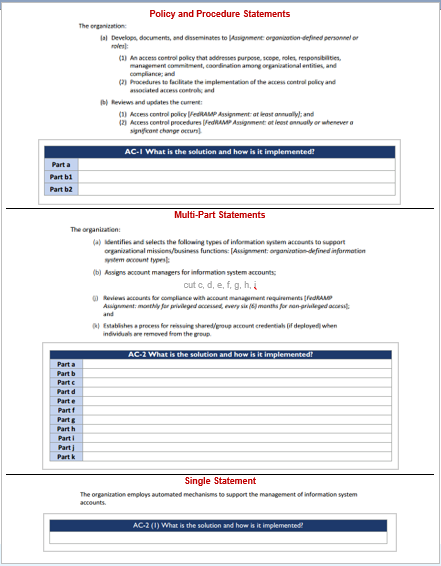
Organization: Policy and Procedure Statements
For each of the -1 controls, such as AC-1, there must be exactly fourfive
statement assemblies: Part (a)(1), Part (a)(2), Part (b), Part (c)(1), and Part
(b)c)(2).
Policy and Procedure Representation
<!-- system-implementation -->
<control-implementation>
    <!-- cut -->
    <implemented-requirement uuid="uuid-value" control-id="ac-1">
        <statement statement-id="ac-1_smt.a.1"><!-- cut --></statement>
        <statement statement-id="ac-1_smt.a.2"><!-- cut --></statement>
        <statement statement-id="ac-1_smt.b.b"><!-- cut --></statement>
        <statement statement-id="ac-1_smt.c.1"><!-- cut --></statement>
        <statement statement-id="ac-1_smt.b.c.2"><!-- cut --></statement>
    </implemented-requirement>
</control-implementation>
Organization: Multi-Part Statements
There must be one statement assembly for each lettered part, such as with AC-2, parts a, b, c, etc.
Multi-Part Statement Representation
<!-- system-implementation -->
<control-implementation>
    <!-- cut -->
    <implemented-requirement uuid="uuid-value" control-id="ac-2">
        <statement statement-id="ac-2_smt.a"><!-- cut --></statement>
        <!-- repeat for b, c, d, e, f, g, h, i, j -->
        <statement statement-id="ac-2_smt.k"><!-- cut --></statement>
    </implemented-requirement>
</control-implementation>
Organization: Single Statement
If there are no lettered parts in the control definition, such as with AC-2 (1), there must be exactly one statement assembly.
Single-Statement Representation
<!-- system-implementation -->
<control-implementation>
    <!-- cut -->
    <implemented-requirement control-id="ac-2.1">
        <statement statement-id="ac-2.1_smt"><!-- cut --></statement>
    </implemented-requirement>
</control-implementation>
Response: Overview
Within each statement assembly, all responses must be provided within
one or more by-component assemblies. There must always be a component
defined in the system-implementation representing the system as a whole
("THIS SYSTEM"), even if individual components are defined that
comprise the system. See the Working with Components section for more information.
An OSCAL-based FedRAMP SSP should define individual components of the system. Components are not just hardware and software. Policies, processes, FIPS 140 validation information, interconnections, services, and underlying systems (leveraged authorizations) are all components.
With OSCAL, the content in the cell next to Part a must be broken down into its individual components and responded to separately.
{{< figure src="/img/ssp-figure-36.png" title="SSP Template Security Control Description" alt="Screenshot of an SSP template security control description." >}}
- For Part a
- Component - This System
- Describes how part a is satisfied holistically, or where the description does not fit with a defined component.
- Component - Platform
- Describes how part a is satisfied by the platform.
- Component - Web-Server
- Describes how part a is satisfied by the web server.
- Component - Process
- Describes how part a is satisfied by an identified process within this organization.
- Component - Inherited
- Describes what is inherited from the underlying Infrastructure as a Service (IaaS) provider to satisfy part a.
- Component - This System
- For Part b
- Component - This System
- Describes how part b is satisfied holistically, or where the description does not fit with a defined component.
- Component - Platform
- Describes how part b is satisfied by the platform.
- Component - Web-Server
- Describes how part b is satisfied by the web server.
- Component - Process
- Describes how part b is satisfied by an identified process within this organization.
- Component - Inherited
- Describes what is inherited from the underlying Infrastructure as a Service (IaaS) provider to satisfy part b.
- Component - This System
The following are examples.
Response: Example
Within each of the statement assemblies, all responses appear in one or
more by-component assemblies. Each by-component assembly references a component defined in the system-implementation assembly.
{{< figure src="/img/ssp-figure-37.png" title="SSP Template Security Control Response" alt="Figure illustrating how component-level control implementation statements are used in OSCAL control implementation statements." >}}
Representation
<system-implementation>
    <!-- leveraged-authorization, user -->
    <component uuid="uuid-value" type="software">
        <title>Component Title</title>
        <description>
            <p>Description of the component.</p>
        </description>
        <status state="operational"/>
    </component>

    <component uuid="uuid-value" type="process">
        <title>Process Title</title>
        <description>
            <p>Description of the component.</p>
        </description>
        <status state="operational"/>
        <responsible-role role-id="admin-unix">
            <party-uuid>3360e343-9860-4bda-9dfc-ff427c3dfab6</party-uuid>
        </responsible-role>
    </component>
</system-implementation>

<control-implementation>
    <!-- cut -->
    <implemented-requirement uuid="uuid-value" control-id="ac-2">
        <statement uuid="uuid-value" statement-id="ac-2_smt.a">

            <by-component uuid="uuid-value" component-uuid="uuid-of-software-component">
                <description>
                    <p>Describe how the software component is satisfying the control.</p>
                </description>
            </by-component>
            <by-component uuid="uuid-value" component-uuid="uuid-of-process-component">
                <description>
                    <p>Describe how the process satisfies the control.</p>
                </description>
            </by-component>
            <!-- repeat by-component assembly for each component related to part a. -->

        </statement>
        <!-- repeat statement assembly for statement part (b, c, etc.) as needed. -->
    </implemented-requirement>
</control-implementation>
<!-- back-matter -->
NOTES:
- All
statement-idvalues must be cited as they appear in the NIST SP 800-53, Revision 4 or Revision 5 OSCAL catalogs:
https://github.com/usnistgov/oscal-content/tree/master/nist.gov/SP800-53
Response: "This System" Component
There must always be a "This System" component in the SSP. This is used in several ways:
-
Holistic Overview: The SSP author may wish to provide a more holistic overview of how several components work together, even if details are provided individually in other
by-componentassemblies. -
Catch-all: Any control response that does not cleanly align with another system component may be described in the "This System" component.
-
Legacy SSP Conversion: When converting a legacy SSP to OSCAL, the legacy control response statements may initially be associated with the "This System" component until the SSP author is able to provide responses for individual components.
{{< figure src="/img/ssp-figure-38.png" title="SSP Template Security Control Response" alt="Figure illustrating how legacy SSP template control response is broad and should apply to the 'this-system' component in OSCAL." >}}
Representation
<system-implementation>
    <!-- leveraged-authorization, user -->
    <component uuid="uuid-value" type="this-system">
        <title>This System</title>
        <description>
            <p>Description of the component.</p>
        </description>
        <status state="operational"/>
    </component>
</system-implementation>

<control-implementation>
    <!-- cut -->
    <implemented-requirement uuid="uuid-value" control-id="ac-2">
        <statement uuid="uuid-value" statement-id="ac-2_smt.a">

            <by-component uuid="uuid-value" component-uuid="uuid-of-this-system-component">
                <description>
                    <p>Describe how individual components are working together.</p>
                    <p>Describe how the system - as a whole - is satisfying this statement.</p>
                    <p>This can include policy, procedures, hardware, software, etc.</p>
                </description>
            </by-component>

        </statement>
        <!-- repeat statement assembly for statement part (b, c, etc.) as needed. -->
    </implemented-requirement>
</control-implementation>
<!-- back-matter -->
NOTES:
- Although the name of the component is "This System", non-technical solutions may also be discussed here, such as policies and procedures.
Linking to Artifacts
Any time policies, procedures, plans, and similar documentation are cited in a control response, they must be linked.
For the legacy approach, when responding within the by-component
assembly for "this system", the link must be within the same by-component assembly where the artifact is cited.
{{< figure src="/img/ssp-figure-39.png" title="SSP Template Security Control Response" alt="Figure illustrating how legacy SSP template control response should link to the appropriate artifact." >}}
Representation: Legacy Approach Example - No Policy Component
<control-implementation>
    <implemented-requirement uuid="uuid-value" control-id="ac-1">
        <statement uuid="uuid-value" statement-id="ac-1_smt.a">
            <by-component component-uuid="uuid-of-this-system" uuid="uuid-value">
                <description>
                    <p>Describe how Part a is satisfied within the system.</p>
                </description>
                <link href="#uuid-of-policy-resource-in-back-matter" rel="policy" />
            </by-component>
        </statement>
    </implemented-requirement>
</control-implementation>
<!-- back-matter -->
For the component approach, use the component representing the policy.
The link should be in the component, but may be added directly to the
by-component as well.
Representation: Component Approach Example
<system-implementation>
    <!-- leveraged-authorization, user -->
    <component uuid="uuid-value" type="policy">
        <title>Access Control and Identity Management Policy</title>
        <description>
            <p>An example component representing a policy.</p>
        </description>
        <link href="#uuid-of-policy-resource-in-back-matter" rel="policy" />
        <status state="operational"/>
    </component>
</system-implementation>
<control-implementation>
    <implemented-requirement uuid="uuid-value" control-id="ac-1">
        <statement uuid="uuid-value" statement-id="ac-1_smt.a">
            <by-component component-uuid="uuid-of-policy-component" uuid="uuid-value">
                <description>
                    <p>Describe how this policy satisfies Part a.</p>
                </description>
            </by-component>
        </statement>
    </implemented-requirement>
</control-implementation>
<!-- back-matter -->
For either example above, the policy must be present as a resource in back-matter.
In Back Matter
<back-matter>
    <resource uuid="uuid-value">
        <title>Access Control and Identity Management Policy</title>
        <rlink media-type="application/pdf" href="./documents/policies/sample_policy.pdf" />
        <base64 filename="sample_policy.pdf" media-type="application/pdf">00000000</base64>
    </resource>
</back-matter>
Response: Identifying Inheritable Controls and Customer Responsibilities
For systems that may be leveraged, OSCAL enables a robust mechanism for providing both inheritance details as well as customer responsibilities (referred to as consumer responsibilities by NIST). OSCAL is designed to enable leveraged and leveraging system SSP details to be linked by tools for validation.
Within the appropriate by-component assembly, include an export
assembly. Use provided to identify a capability that may be inherited by a leveraging system. Use responsibility to identify a customer responsibility. If a responsibility must be satisfied to achieve inheritance, add the
provided-uuid flag to the responsibility field.
Representation
<!-- system-implementation -->
<control-implementation><!-- cut -->
    <implemented-requirement uuid="uuid-value" control-id="ac-2">
        <statement uuid="uuid-value" statement-id="ac-2_smt.a">
            <by-component uuid="uuid-value" component-uuid="uuid-of-this-system-component">
                <description>
                    <p>Describe how the system - as a whole - is satisfying this statement.</p>
                </description>
                <export>
                    <responsibility uuid="uuid-value">
                        <description>
                            <p>Leveraging system's responsibilities in satisfaction of AC-2.</p>
                            <p>Not linked to inheritance, so this is always required.</p>
                        </description>
                        <responsible-role role-id="customer" />
                    </responsibility>
                </export>
            </by-component>
            <by-component uuid="uuid-value" component-uuid="uuid-of-software-component">
                <description>
                    <p>Describe how the software is satisfying this statement.</p>
                </description>
                <export>
                    <provided uuid="uuid-value">
                        <description>
                            <p>Customer appropriate description of what may be inherited.</p>
                        </description>
                        <responsible-role role-id="poc-for-customers" />
                    </provided>

                    <responsibility uuid="uuid-value" provided-uuid="uuid-of-provided">
                        <description>
                            <p>Customer responsibilities if inheriting this capability.</p>
                        </description>
                        <responsible-role role-id="customer" />
                    </responsibility>
                </export>
            </by-component>
        </statement>
    </implemented-requirement>
</control-implementation>
See the XPath Queries for Control Implementation Descriptions section.
See the NIST OSCAL Leveraged Authorization Presentation for more information.