
Responding By Component
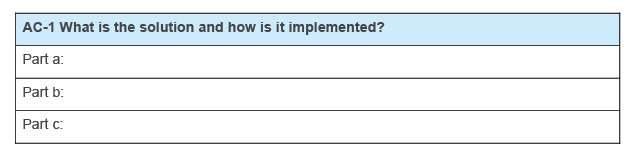
OSCAL SSPs represent control responses in control-implementation / implemented-requirements / statements.
See Control Implementation Statements to understand how to associate control responses with specific baseline controls and control statements.
Within statements, all responses must be assocaited with one or more components via the by-components array.
OSCAL enables you to be as granular as you wish. Individual components may be added for operating systems, container images, firewalls, policies, procedures and plans. There is always a "this-system" component representing the entire system / authorization-boundary.
The "This System" Component
There must always be a "This System" component defined in the SSP. For control responses, this is used in several ways:
-
Holistic Overview: The SSP author may wish to provide a more holistic overview of how several components work together, even if details are provided individually in other
by-componentassemblies. -
Catch-all: Any control response that does not cleanly align with another system component may be described in the "This System" component.
-
Legacy SSP Conversion: When converting a legacy SSP to OSCAL, the legacy control response statements may initially be associated with the "This System" component until the SSP author is able to provide responses for individual components.
responses occur within by-components / description.
In a legacy Word-based SSP, it was often necessary to provide narriative for each relevant component in a control response. The entire narriative for all components was captured in a single table cell as separate paragraphs.
With OSCAL, you have the option of keeping a single narriative block, or breaking out a control response by its discrete components.
Retrofit Adoption Path MVP
When converting a Word-based FedRAMP SSP to OSCAL, move all control responses to the this-system component.
Every OSCAL SSP must have a this-system component defined. It is the only required component.
system-security-plan:
  system-implementation:
    components:
    - uuid: 11111111-2222-4000-8000-009000000000
      type: this-system
      title: This System
      description: 'Represents the entire authorization boundary'
      status:
        state: operational
Every statements / by-components array has exactly one entry that references the this-system component and includes the content from the Word-based SSP.
Each statements array entry includes:
- a required
uuidfield - a required
by-componentsarray. Each array entry includes:- a required
component-uuidfield that cites thethis-sytemcomponent from above. - a required
uuidfield - a required
descriptionfield that contains the content from the Word-based SSP control response. - a required
implementation-statuselement with:- a required
statefield with a value of ofimplemented.
- a required
- a required
system-security-plan:
  control-implementation:
    description: n/a.
    implemented-requirements:
    - uuid: 11111111-2222-4000-8000-012000010000
      control-id: ac-1
      statements:
      - statement-id: ac-1_smt.a
        uuid: 11111111-2222-4000-8000-012000010100
        by-components:
        - component-uuid: 11111111-2222-4000-8000-009000000000
          uuid: 11111111-2222-4000-8000-012000010101
          description: Word-based SSP AC-1, statement a response.
          implementation-status:
            state: implemented
      - statement-id: ac-1_smt.b
        uuid: 11111111-2222-4000-8000-012000010200
        by-components:
        - component-uuid: 11111111-2222-4000-8000-009000000000
          uuid: 11111111-2222-4000-8000-012000010201
          description: Word-based SSP AC-1, statement b response.
      - statement-id: ac-1_smt.c
        uuid: 11111111-2222-4000-8000-012000010300
        by-components:
        - component-uuid: 11111111-2222-4000-8000-009000000000
          uuid: 11111111-2222-4000-8000-012000010301
          description: Word-based SSP AC-1, statement c response.
          implementation-status:
            state: implemented
See the Example below.
Native Adoption Path
When creating an SSP from scratch, ensure appropriate components are defined before authoring a control response. The this-system component must always be present. Other components are present baed on their use within the sytem. See Components for more information.
system-security-plan:
  system-implementation:
    components:
    - uuid: 11111111-2222-4000-8000-009000000000
      type: this-system
      title: This System
      description: 'Represents the entire authorization boundary'
      status:
        state: operational

    - uuid: 11111111-2222-4000-8000-009000600001
      type: policy
      title: Access Control and Identity Management Policy
      description: 'A corporate policy used for the system.'
      status:
        state: operational
Every statements / by-components array has one or more entries that reference components describes how that component is satisfying that control requirement statement.
Each statements array entry includes:
- a required
uuidfield - a required
by-componentsarray. Each array entry includes:- a required
component-uuidfield that cites the appropriate component from above. - a required
uuidfield - a required
descriptionfield that contains the content from the Word-based SSP control response. - a required
implementation-statuselement with:- a required
statefield with a value of ofimplemented.
- a required
- a required
system-security-plan:
  control-implementation:
    description: n/a.
    implemented-requirements:
    - uuid: 11111111-2222-4000-8000-012000010000
      control-id: ac-1
      statements:
      - statement-id: ac-1_smt.a
        uuid: 11111111-2222-4000-8000-012000010100
        by-components:

        - component-uuid: 11111111-2222-4000-8000-009000600001
          uuid: 11111111-2222-4000-8000-012000010102
          description: Describe how this policy satisfies part a.
          implementation-status:
            state: implemented

        - component-uuid: 11111111-2222-4000-8000-009000000000
          uuid: 11111111-2222-4000-8000-012000010101
          description: "Provide general context about satisfying part a that doesn't fit a defined component."
          implementation-status:
            state: implemented
Example
IA-2An IdentificaitonIA and Authentication (Organizational Users)Control is satisfied by a combination of:
- the IA
PolicyPolicy, anand IAProcedureProcedure, - a container running
KeyCloakKeyCloak, - and an enterprise directory
capability
This was originally described in the the IA-2 narriative as:
All components requiring authentication are configured to redirect users to KeyCloak. When a user supplies their ID and KeyCloak recognizes it as belonging to this organization, it redirects the user's authentication attempt to the enterprise directory capability for authentication. The enterprise directory reports the user's authentication success or failure back to KeyCloak. If authentication is successful, KeyCloak generates an access token and passes it back to the compnent requesting authentication.
The IA Policy requires use of the enterprise directory for authentication of organizational users. The system-level IA Procedure provides instructions for admins to configure their compoents to use KeyCloak for authentication.
Within the OSCAL SSP, this entire statement can initially be assocaited with the "this-system" component in the by-component response to AC-2.
by-component(this-system)
All components requiring authentication are configured to redirect users to KeyCloak. When a user supplies their ID and KeyCloak recognizes it as belonging to this organization, it redirects the user's authentication attempt to the enterprise directory capability for authentication. The enterprise directory reports the user's authentication success or failure back to KeyCloak. If authentication is successful, KeyCloak generates an access token and passes it back to the compnent requesting authentication.
The IA Policy requires use of the enterprise directory for authentication of organizational users. The system-level IA Procedure provides instructions for admins to configure their compoents to use KeyCloak for authentication.
Moving Toward Normalization
At a later date, the SSP author can define components for the IA Policy and system-level IA Procedure and associate them with AC-2. The content shifts to be represented like this:
by-component(this-system)
All components requiring authentication are configured to redirect users to KeyCloak. When a user supplies their ID and KeyCloak recognizes it as belonging to this organization, it redirects the user's authentication attempt to the enterprise directory capability for authentication. The enterprise directory reports the user's authentication success or failure back to KeyCloak. If authentication is successful, KeyCloak generates an access token and passes it back to the compnent requesting authentication.
by-component(policy)
The IA Policy requires use of the enterprise directory for authentication of organizational users.
by-component(process-procedure)
The system-level IA Procedure provides instructions for admins to configure their compoents to use KeyCloak for authentication.
Fully Normalized
Eventually, components are added for KeyCloak and the enterprise directory; however, some of this narriative describes how the two work together. The this-system component can still be used for any narriative that doesn't fit cleanly in another component.
by-component(this-system)
All components requiring authentication are configured to redirect users to KeyCloak.
by-component(software/ KeyCloak)
When a user supplies their ID and KeyCloak recognizes it as belonging to this organization, it redirects the user's authentication attempt to the enterprise directory capability for authentication.
If authentication is successful, KeyCloak generates an access token and passes it back to the compnent requesting authentication.
by-component(service/ enterprise directory)
The enterprise directory reports the user's authentication success or failure back to KeyCloak.
by-component(policy)
The IA Policy requires use of the enterprise directory for authentication of organizational users.
by-component(process-procedure)
The system-level IA Procedure provides instructions for admins to configure their compoents to use KeyCloak for authentication.
This is now fully normalized.capability.