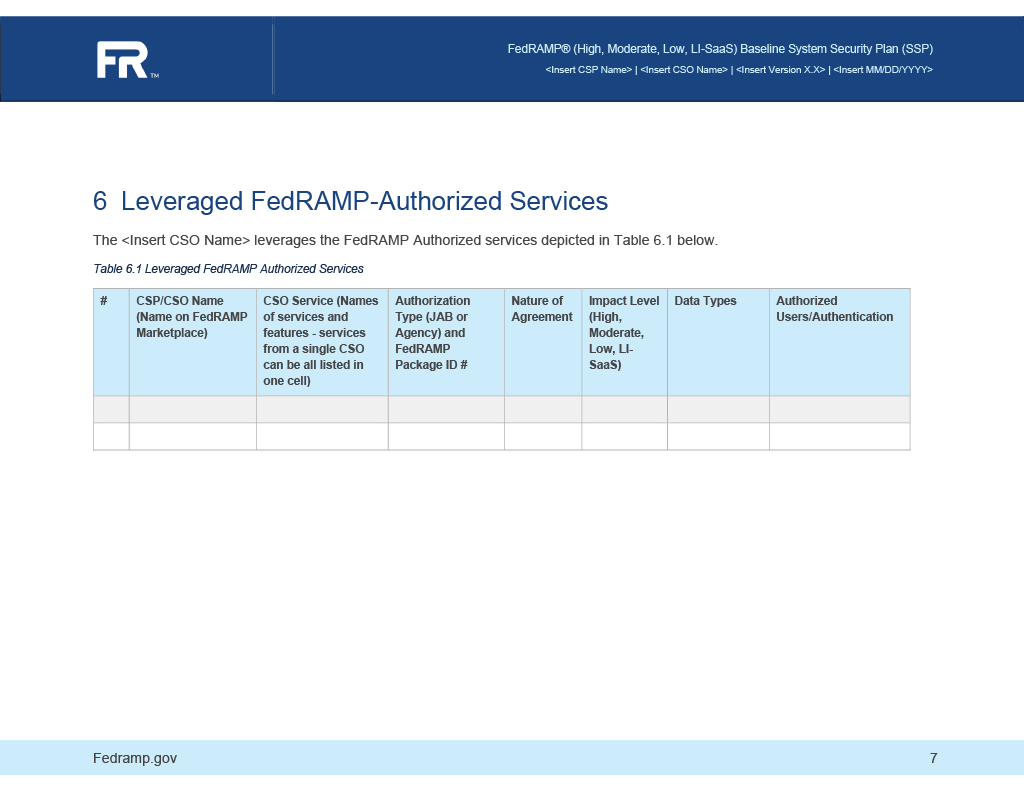
Leveraged Authorizations and Authorized Services
If this system is leveraging the authorization of one or more systems, such as a SaaS running on an IaaS, each leveraged system must be represented within the system-implementation assembly. There must be one leveraged-authorization assembly and one matching component assembly for each leveraged authorization.
If the leveraged system owner provides a UUID for their system, such as in an OSCAL-based Inheritance and Responsibility document (similar to a CRM), it should be provided as the inherited-uuid property value.
IMPORTANT FOR LEVERAGED SYSTEMS:
While a leveraged system has no need to represent content here, its SSP must include special inheritance and responsibility information in the individual controls. See the Response: Identifying Inheritable Controls and Customer Responsibilities section for more information.
OSCAL Representation
<metadata>
    <!-- CSP name -->
    <party uuid="uuid-value">
        <name>Example IaaS Provider</name>
        <short-name>E.I.P.</short-name>
    </party>
</metadata>
<!-- cut import-profile, system-characteristics -->
<system-implementation>
    <leveraged-authorization uuid="uuid-value" >
        <title>Name of Underlying System</title>
        <!-- FedRAMP Package ID -->
        <prop name="leveraged-system-identifier"
            ns="https://fedramp.gov/ns/oscal"
            value="Package_ID value" />
        <prop ns="https://fedramp.gov/ns/oscal" name="authorization-type"
              value="fedramp-agency"/>
        <prop ns="https://fedramp.gov/ns/oscal" name="impact-level" value="moderate"/>
        <link href="//path/to/leveraged_system_legacy_crm.xslt" />
        <link href="//path/to/leveraged_system_responsibility_and_inheritance.xml" />
        <party-uuid>uuid-of-leveraged-system-poc</party-uuid>
        <date-authorized>2015-01-01</date-authorized>
    </leveraged-authorization>
    <!-- CSO name & service description -->
    <component uuid="uuid-of-leveraged-system" type="leveraged-system">
        <title>Name of Leveraged System</title>
        <description>
            <p>Briefly describe leveraged system.</p>
        </description>
        <prop name="leveraged-authorization-uuid"
              value="5a9c98ab-8e5e-433d-a7bd-515c07cd1497" />
        <prop name="inherited-uuid" value="11111111-0000-4000-9001-000000000001" />
        <prop name="implementation-point" value="external"/>
        <!-- FedRAMP prop extensions for table 6.1 columns -->
        <status state="operational"/>
    </component>
</system-implementation>
The title field must match an existing FedRAMP authorized Cloud_Service_Provider_Package property value.
A leveraged-system-identifier property must be provided within each leveraged-authorization field. The value of this property must be from the same Cloud Service Provider as identified in the title field.
XPath Queries
Name of first leveraged system:
        /*/system-implementation/leveraged-authorization[1]/title
    Name of first leveraged system CSO service (component):
        (//*/component/prop[@name="leveraged-authorization-uuid" and @value="uuid-of-leveraged-system"]/parent::component/title)[1]
    Description of first leveraged system CSO service (component):
        (//*/component/prop[@name="leveraged-authorization-uuid" and @value="uuid-of-leveraged-system"]/parent::component/description)[1]
    Authorization type of first leveraged system:
        /system-security-plan/system-implementation[1]/leveraged-authorization[1]/prop[@ns="https://fedramp.gov/ns/oscal" and @name="authorization-type"]/@value
    FedRAMP package ID# of the first leveraged system:
        /system-security-plan/system-implementation[1]/leveraged-authorization[1]/prop[@ns="https://fedramp.gov/ns/oscal" and @name="leveraged-system-identifier"]/@value
    Nature of Agreement for first leveraged system:
        (//*/component/prop[@name="leveraged-authorization-uuid" and @value="uuid-of-leveraged-system"]/parent::component/prop[@ns="https://fedramp.gov/ns/oscal" and @name="nature-of-agreement"]/@value)[1]
    FedRAMP impact level of the first leveraged system:
        /system-security-plan/system-implementation[1]/leveraged-authorization[1]/prop[@ns="https://fedramp.gov/ns/oscal" and @name="impact-level"]/@value
    Data Types transmitted to, stored or processed by the first leveraged system CSO:
        (//*/component/prop[@name="leveraged-authorization-uuid" and @value="uuid-of-leveraged-system"]/parent::component/prop[@ns="https://fedramp.gov/ns/oscal" and @name="interconnection-data-type"]/@value)
    Authorized Users of the first leveraged system CSO:
        //system-security-plan/system-implementation/user[@uuid="uuid-of-user"]
    Corresponding Access Level:
        //system-security-plan/system-implementation/user[@uuid="uuid-of-user"]/prop[@name="privilege-level"]/@value
    Corresponding Authentication method:
        //system-security-plan/system-implementation/user[@uuid="uuid-of-user"]/prop[@ns="https://fedramp.gov/ns/oscal" and @name="authentication-method"]/@value
Replace XPath predicate "[1]" with "[2]", "[3]", etc.