
6. Leveraged FedRAMP-Authorized Services
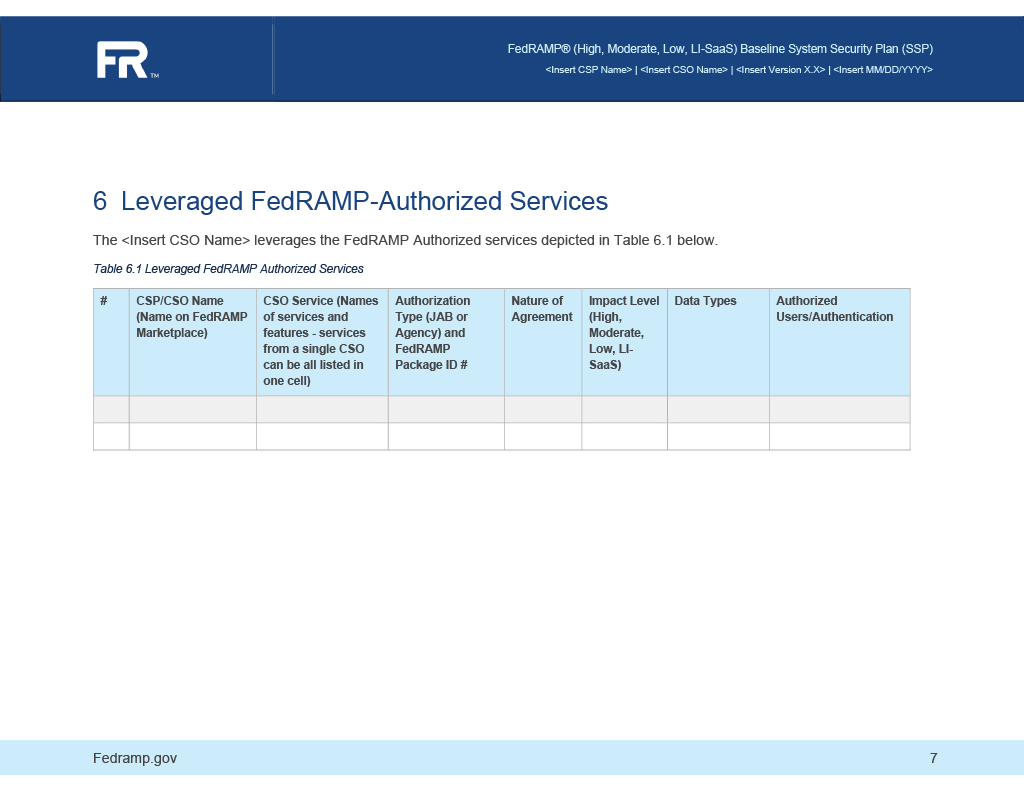
The minimum required content for representing a leveraged authorization is:
- a
partiesentry to indicate the organizaiton that owns the leveraged system - a
leveraged-authorizationsentry to provide primary details about the leveraged authoriation
In order to allocate control inheritence to a leveraged authorization, the following additional content is also required:
- a
componentsentry representing the leveraged system
IMPORTANT FOR LEVERAGED SYSTEMS:
While a leveraged system has no need to represent content here, its SSP must include special inheritance and responsibility information in the individual controls. See the Response: Identifying Inheritable Controls and Customer Responsibilities section for more information.
OSCAL Representation
<metadata>
    <!-- CSP name -->
    <party uuid="uuid-value">
        <name>Example IaaS Provider</name>
        <short-name>E.I.P.</short-name>
    </party>
</metadata>
<!-- cut import-profile, system-characteristics -->
<system-implementation>
    <leveraged-authorization uuid="uuid-value" >
        <title>Name of Underlying System</title>
        <!-- FedRAMP Package ID -->
        <prop name="leveraged-system-identifier"
            ns="https://fedramp.gov/ns/oscal"
            value="Package_ID value" />
        <prop ns="https://fedramp.gov/ns/oscal" name="authorization-type"
              value="fedramp-agency"/>
        <prop ns="https://fedramp.gov/ns/oscal" name="impact-level" value="moderate"/>
        <link href="//path/to/leveraged_system_legacy_crm.xslt" />
        <link href="//path/to/leveraged_system_responsibility_and_inheritance.xml" />
        <party-uuid>uuid-of-leveraged-system-poc</party-uuid>
        <date-authorized>2015-01-01</date-authorized>
    </leveraged-authorization>
    <!-- CSO name & service description -->
    <component uuid="uuid-of-leveraged-system" type="leveraged-system">
        <title>Name of Leveraged System</title>
        <description>
            <p>Briefly describe leveraged system.</p>
        </description>
        <prop name="leveraged-authorization-uuid"
              value="5a9c98ab-8e5e-433d-a7bd-515c07cd1497" />
        <prop name="inherited-uuid" value="11111111-0000-4000-9001-000000000001" />
        <prop name="implementation-point" value="external"/>
        <!-- FedRAMP prop extensions for table 6.1 columns -->
        <status state="operational"/>
    </component>
</system-implementation>
The title field must match an existing FedRAMP authorized Cloud_Service_Provider_Package property value.
A leveraged-system-identifier property must be provided within each leveraged-authorization field. The value of this property must be from the same Cloud Service Provider as identified in the title field.
If this system is running on top of another FedRAMP-authorized cloud service offering, leveraging the authorization of one or more systems, such as a SaaS running on an IaaS, each leveraged system must be represented within the system-implementation assembly. There must be one leveraged-authorization assembly and one matching component assembly for each leveraged authorization.
If the leveraged system owner provides a UUID for their system, such as in an OSCAL-based Inheritance and Responsibility document (similar to a CRM), it should be provided as the inherited-uuid property value.