
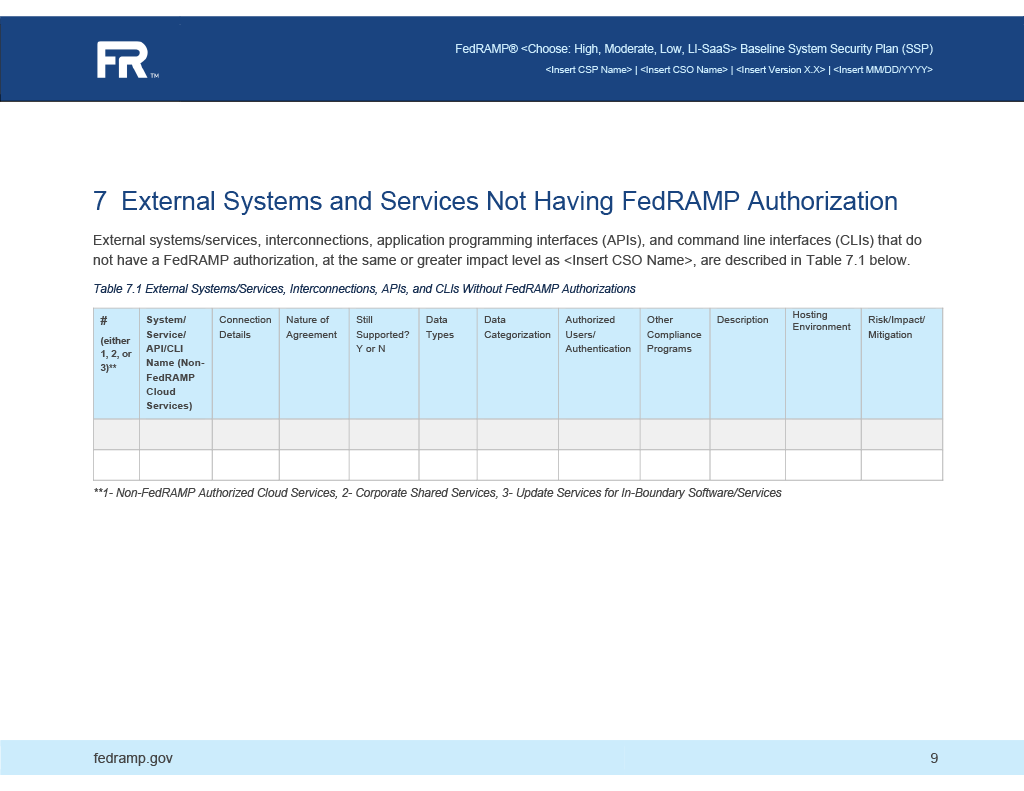
7. External Systems and Services Not Having FedRAMP Authorization
OSCAL Representation
system-security-plan:
  system-implementation:
    component:
      uuid: 11111111-2222-4000-8000-009000200001
      type: interconnection
      title: "[EXAMPLE]External System / Service Name"
      description: "Briefly describe the interconnection details."
      prop:
        - ns: "https://fedramp.gov/ns/oscal"
          name: service-processor
          value: "[SAMPLE] Telco Name"
        - ns: "https://fedramp.gov/ns/oscal"
          name: interconnection-type
          value: "1"
        - name: direction
          value: incoming
        - name: direction
          value: outgoing
        - ns: "https://fedramp.gov/ns/oscal"
          name: nature-of-agreement
          value: contract
        - ns: "https://fedramp.gov/ns/oscal"
          name: still-supported
          value: yes
        - ns: "https://fedramp.gov/ns/oscal"
          class: fedramp
          name: interconnection-data-type
          value: "C.3.5.1"
        - ns: "https://fedramp.gov/ns/oscal"
          class: fedramp
          name: interconnection-data-type
          value: "C.3.5.8"
        - ns: "https://fedramp.gov/ns/oscal"
          class: "C.3.5.1"
          name: interconnection-data-categorization
          value: low
        - ns: "https://fedramp.gov/ns/oscal"
          class: "C.3.5.8"
          name: interconnection-data-categorization
          value: moderate
        - ns: "https://fedramp.gov/ns/oscal"
          name: authorized-users
          value: "SecOps engineers"
        - ns: "https://fedramp.gov/ns/oscal"
          class: fedramp
          name: interconnection-compliance
          value: "PCI SOC 2"
        - ns: "https://fedramp.gov/ns/oscal"
          class: fedramp
          name: interconnection-compliance
          value: "ISO/IEC 27001"
        - ns: "https://fedramp.gov/ns/oscal"
          name: interconnection-hosting-environment
          value: PaaS
        - ns: "https://fedramp.gov/ns/oscal"
          name: interconnection-risk
          value: None
        - name: isa-title
          value: "system interconnection agreement"
        - name: isa-date
          value: "2023-01-01T00:00:00Z"
        - name: ipv4-address
          class: local
          value: "10.1.1.1"
        - name: ipv4-address
          class: remote
          value: "10.2.2.2"
        - name: ipv6-address
          value: "::ffff:10.2.2.2"
        - ns: "https://fedramp.gov/ns/oscal"
          name: information
          value: "Describe the information being transmitted."
        - ns: "https://fedramp.gov/ns/oscal"
          name: port
          class: remote
          value: "80"
        - ns: "https://fedramp.gov/ns/oscal"
          name: interconnection-security
          value: ipsec
          link:
            - href: "#uuid-of-ICA-resource-in-back-matter"
              rel: isa-agreement
  back-matter:
    resource:
      uuid: "11111111-2222-4000-8000-001000000050"
      title: "[SAMPLE]Interconnection Security Agreement Title"
      props:
      - name: published
        value: '2023-01-01T00:00:00Z'
      - name: version
        value: Document Version
      - name: type
        value: agreement
        class: interconnection-security-agreement
      rlinks:
      - href: ./attachments/ISAs/ISA-1.docx
External System and Services
To map the legacy FedRAMP SSP table for External Systems and Services into a machine-readable OSCAL format, the data is primarily stored within the system-implementation section, specifically under component definitions where the type is set to interconnection.
The following data points are captured using various OSCAL fields and FedRAMP-specific properties (prop):
- Identity & Nature: The system, service, or API name is defined by the component
title, while the specificinterconnection-type(e.g., dedicated line, VPN) and thenature-of-agreement(e.g., MOU, ISA) are captured as properties. - Operational Details: Connection characteristics are recorded via properties for
direction(inbound/outbound), whether the service isstill-supported(Y/N), and a generaldescriptionof the interface. - Data Characteristics: The
data-typeand its associateddata-categorization(Security Impact Level) are explicitly defined to track what information is leaving or entering the boundary. - User Access: Information regarding
authorized-usersand their specificprivilege-levelis linked back to theuserdefinitions within the system implementation. - Compliance & Risk: Any
other-compliance-programs(like SOC2 or ISO), the specifichosting-environment, and a summary of therisk-impact-mitigationstrategies are all stored as specific metadata properties attached to the interconnection component.
When documenting multiple external services, each service is treated as a separate instance of an interconnection component within the OSCAL file.
No comments to display
Todo: Convert XPath queries to JSON Pointer
In reply to #1
We have agreed to skip any form of path for now.
No comments to display